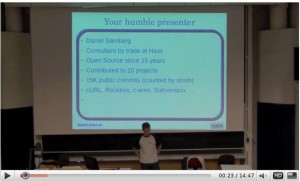
My FSCONS 2009 libssh2 slides

Wednesday, November 18th, 2009

I also did a talk about libssh2 at FSCONS 2009 (in addition to the Rockbox talk) and the slides from it are now available to browse or download.

The talk was recorded on video, and I’ll make sure to let you know as soon as it is available online somewhere. That might take a while.

My previous libssh2 talk on video

Saturday, November 14th, 2009

Remember how I mentioned back in August thatI held a libssh2 talk at Slackathon? The other day I recalled that I never saw that video recording so I tracked it down and found it. So while you’re waiting to see the video of my libssh2 or Rockbox talks I did today at FSCONS, you can enjoy a slightly shorter version:

libssh2 Slackathon 2009

My Nordic Free Software Awards 2009 nominees

Friday, September 25th, 2009

Hey, it’s really about time to nominate your favourite Free Software persons and projects from the nordic region for the 2009 awards before the time runs out.

This year, I decided to nominate the following “nordic” heroes:

Simon Josefsson

For his excellent work in GnuTLS, libssh2 and a bunch of other projects.

Henrik Nordström

For his work in the Squid project, and his efforts within IETF and its HTTP related struggles and more.

Björn Stenberg

As the primary founder of the Rockbox project. He started somehting special back in 2001 that now is a huge, thriving and succesful Free Software project.

As you might spot, I favor “doers”. I don’t believe in the concept of “nordic projects” when it comes to free or open software – the entire concept of open and free should mean that projects cross borders and regions.

In fact, it feels so out of the ordinary to think about open source people in a geographical context I find it hard to come up with a lot of names. It would be cool if ohloh had some ways to list people and projects based on where people live.

Then again, if a person from a nordic country moves somewhere else, is he or she still a nordic person? Does it depend on where the person lived during the actual act? Is Linus Torvalds a nordic person since he was born, lived many years and started his big project in Finland?

(yeah I already blogged about this subject but hey, it can’t hurt can it?)

How much for a bug?

Monday, September 14th, 2009

no bugsWarning: blog post with no clear conclusion!

I offer support deals to companies that want to get help with Open Source programs I’ve contributed to. The deals I’ve made so far have primarily involved libcurl, c-ares or libssh2, but that’s basically because those are projects in which I participate a lot in (and maintain) so people find me easily in relation to those projects.

I wouldn’t mind accepting service and support deals for other projects or softwares either, as long as they are softwares I know and am fairly familiar with already and I am not scared of digging in and fixing things under the hood when that is required.

In fact, I could very well consider to offer to fix bugs in any Open Source software. Like a general: if you have a bug in an open source project that you really want fixed and you can’t do it yourself I might be your man. Of course this would be limited to some certain kinds of projects and programs, but it could still include a wide range of softwares. A lot more than the ones I happen to be involved in at any particular point in time.

But while “a bug” is a fairly easily defined term to a user who can’t make something work in a given program it can be anything from dead simple to downright impossible for a developer to fix. The fact that users many times cannot determine if a “bug” is hard or easy, if it’s a bug or a feature not working on purpose, makes such a business deal very hard to provide.

How to pay to get a bug fixed?

Fixed price per bug? Presumably only tricky bugs would be considered for this so it would require a fairly high fixed price. But then it’ll also never be used for simple bugs either since the fixed price would scare away such use cases. I don’t think a fixed-price scheme works very well for this.One dollar bill

Then we only have a variable price approach left. A common way for a consultant like me is to charge for my time spent on a project: I set an hourly rate, I fix the issue in N hours. I charge hourly rate * N. For smallish projects, this is less attractive to customers. If we have no previous relationship, there’s a trust issue where the customer might not just blindly accept that I worked 10 hours on a task they think sounds easy so they feel overcharged. Also, there’s the risk that I estimate the job to be 2 hours but end up spending 12. My conclusion is that per-hour pricing doesn’t work for this either.

A variable price approach based on something else than number of hours it took for me to fix the problem is therefore needed.

A bug fix is of course worth whatever someone is willing to pay for it. But we don’t know what they are prepared to pay. On the other end, a bug fix can get done by someone for the price he/she is willing to accept to get the job done. So where is the cross section of those two unknown graphs?

I don’t have the answer here. I’m very interested in feedback and suggestions though. If you would pay for a bug fix, how would you like to get the price set?

50 hours offline

Wednesday, August 26th, 2009

Several sites in the haxx.se domain and other stuff related to me and my fellows were completely offline for almost 50 hours between August 24th 19:00 UTC and August 26th 20:30 UTC.

The sites affected included the main web sites for the following projects: curl, c-ares, trio, libssh2 and Rockbox. It also affected mailing lists and CVS repositories etc for some of those.

The reason for the outage has been explained by the ISP (Black Internet) to be because of some kind of sabotage. Their explanation given so far (first in Swedish):

Strax efter kl 20 i måndags drabbades Black Internet och Black Internets kunder av ett mycket allvarligt sabotage. Sabotaget gjordes mot flera av våra core-switchar, våra knutpunkter. Detta resulterade i ett mer eller mindre totalt avbrott för oss och våra kunder. Vi har polisanmält händelsen och har ett bra samarbete med dem.

Translated to English (by me) it becomes:

Soon after 8pm on Monday, Black Internet and its customers were struck by a very serious act of sabotage. The sabotage was made against several of our core switches. This resulted in a more or less total disruption of service for us and our customers. We have reported the incident to the police and we have a good cooperation with them.

Do note that you could keep track of this situation by following me on twitter.

It’s good to be back. Let’s hope it’ll take ages until we go away like that again!

Update: according to my sources, someone erased/cleared Black Internet’s core routers and then they learned that they had no working backups so they had to restore everything by hand.

Slacka-fun!

Tuesday, August 18th, 2009

A bunch of the local OpenBSD fans here in Stockholm run this one-day event every year, called Slackathon. I missed it last year, but in 2007 I was there (and I did a little talk about open source management) and this year I was eager to participate again.

This year, the event was scheduled to take place immediately after a bunch of core OpenBSD developers had had their “hackathon f2k9″ in Stockholm, so they could now boast with a series of very well known and very knowledgeable OpenBSD kernel hackers. As I am really not more than a distant observer of the OpenBSD project this of course put the lights on a lot of dusty corners I had no previous idea about. I’m not really a stranger to kernels and kernel hacking in general, and I must confess I had a great time and the team who spoke of various very detailed kernel topics are charismatic and put on a great show.

So I learned about the terrors of the VFS layer and hacking it (and how they’re working on making all the involved caches dynamically sized). I learned how to do active-active syncing  of pf-based firewalls (basically using two independent firewalls in front of something), or at least how the guys made it work fairly well. Or how the pf firewall was optimized to double its forwarding performance. And I got to hear a few wise words from Theo de Raadt and learn not only about their 6 month release schedules but also their plans and ideas around solving problems with livelocking and more. Not to mention the talk about managing physical memory, or the work to get OpenBSD ported to sparc64s with hardware-based virtualization support.

Taken all the hardcore kernel talks into account, I think my own talk on libssh2 (just before dinner) felt like a very light snack to chew and possibly a tiny bit out of the general topic… Anyway, I gave a quick overview of the project, how it started, why it was started, what it is and a bit how it works etc.

The slides from my slackathon talk. I expect to re-use a fair bunch of that, with some improvements and additions, in my libssh2 talk at FSCONS later this year.

Looking forward to Slackathon 2010!

Pictures from Slackathon 2009 by Vladimir Bogodist.

Me in front of the projector screen doing libssh2 talk

libssh2 1.2 near you!

Monday, August 10th, 2009

After what feels like ages (roughly four months), we’ve managed to cram out yet another release from the libssh2 project. This time the primary new features are around the known host support but as usual we’ve also squashed a bunch of bugs along the way.

Get your own piece of the action from www.libssh2.org.

libssh2

libssh2 at Slackathon 2009

Monday, August 3rd, 2009

I’m scheduled to do a talk about libssh2 on the Slackathon 2009 meeting at Stockholm University, August 15th 2009. The talk will be held in English. See you!

libssh2

I host www.libssh2.org

Friday, July 31st, 2009

Sara Golemon, the founder and former maintainer of libssh2, pointed over the main site www.libssh2.org to my server the other day and now my previously unofficial libssh2 web site suddenly turned out to be the only and official one.

The plan is now to get the web contents push into a separate git repo to allow all libssh2′ers to modify it.

I’m also open and interested in feedback and ideas on how to improve the web site in whatever kind of way you think. Consider the current site mostly a placeholder for the info we have. How can we make it better?

libssh2

libssh2 vs libssh

Sunday, June 14th, 2009

There are only two open source libraries for SSH that I am aware of. At least that are at the fundamental layer, written in C.

I researched the SSH library market years ago when I stuck with libssh2 as the one I thought was most promising, and since then I and others have taken it much further. The lib that I didn’t go with at that time, confusingly enough named libssh, recently came out with a new release.

Since there is now clearly two active open source SSH libraries it feels like we should help our users and potential newcomers by explaining how our projects and libraries differ. As a little teaser: one of the libraries turned out more than twice as fast as the other in my test…

While I admit to not having actually used libssh for real, I’ve read the docs and I’ve tried it a little bit. My take at a comparison is now online at:

http://www.libssh2.org/libssh2-vs-libssh.html

I will highly appreciate your feedback and additional things that differ between the two! The list isn’t really much to boast about as it currently looks!