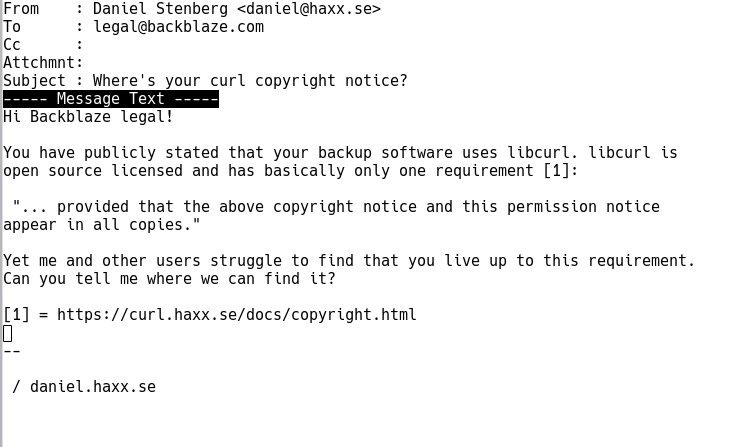
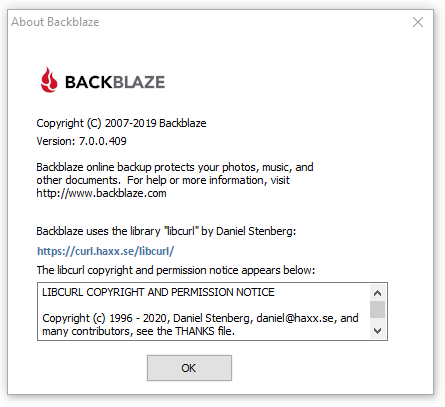
fully respect your rights

Tuesday, August 18th, 2009

This is [name removed] writing at Toshiba Corporation.

We are considering using your program curl (http://curl.haxx.se/) in our products. Before going any further, however, we would like to confirm the following so that we are sure to fully respect your rights.

I am so impressed. Thank you Toshiba for being this upfront and courteous when incorporating an open source product. The license is perfectly free and open for you to use curl for this purpose, but the sheer act of this “making sure” gets my 10 points for great business conduct.

Copyleft and closed dual license ethics

Tuesday, October 14th, 2008

There are a bunch of companies out there today that offer their products in a dual-license style, where you can download and use the GPL licensed version or buy the proprietary licensed version (often together with some kind of service deal) that you then can use without the “burden” of a GPL agreement. Popular known brands doing this include Trolltech/Qt (now Nokia), MySQL (now Sun), OO.o (Sun), Sleepycat (now Oracle) (Berkely DB is not strictly GPL but still copyleft) and VirtualBox (now Sun) etc.

It’s perfectly legal for them to do this, as the company is the copyright holder of all the files, they can just easily re-release everything under whatever license they want at their own discretion. The condition is of course that they are in fact copyright holders of everything, that the parts they don’t have copyright for are either licensed under an enough liberal license or that they can buy a similar relicense from third party lib authors.

It kills contributions from non-employees since doing a large chunk of code for these guys means that you would hand over copyright to a company whose entire business idea is to convert that to a proprietary license and make money from it. In a way you cannot do yourself since they can turn the GPL code into proprietary goods and you cannot. This may be a clue to why MySQL has less community contributors. The forced assigning of copyright over to a company could very well also be a contributing factor to OO.o’s problems to attract developers.

Companies “hide” the truth about this and try talking customers into the proprietary license. I’ve worked a bit with Qt and the wording they have used have often given companies the impression that they have to pay for the proprietary licensed version to be allowed to use the product in a commercial product. I’ve had to explain to several customers that as long as they just adhere to GPL they can use the free version just fine without paying anything. Trolltech also has this dubious condition tied to their commercial license: “The Commercial license does not allow the incorporation of code developed with the Open Source Edition of Qt into a commercial product.“[*] Needless to say, this will prevent companies from trying the open source licensed route first. I’m curious if they even have the legal right to make that claim.

This puts competitors at an arm’s distance of course since no other companies can take the code and conduct business the same way. Of course this is part of the reason why they gladly adapt GPL for this. Lots of actions by these companies make me feel that they aren’t real and true open source believers, but that they use this label a lot for marketing and for making sure competitors can’t do the same as they do.

The GPL version is without support for customers in another push to drive them to pay for the proprietary license instead of the GPL one. Of course, it being open source lets companies going the GPL route to fix their own problems since they have the source and all, but the push towards the proprietary license also narrows how many customers that will actively contribute anything back since there’s little chance they will do anything in a project with a proprietary license. I honestly can’t see many other possible legitimate reasons why companies wouldn’t do support for the GPL licensed versions.

I’ve not personally worked in any of these projects under such proprietary licenses, but I would love to hear experiences from people that have!

Obviously all this are not problems large enough to concern users. Quite possibly so because these companies do a good enough job and keep the GPL versioned versions of their software at a sufficiently good quality so that there just don’t appear any forked projects that take the GPL version and run with it in a different direction. Another explanation could be that there are good enough alternative projects to go with if you’re not happy with one of these dual-licensed ones.

A little related anecdote told to me by an MySQL employee (who’s name shall remain untold). He described how they still haven’t implemented a feature in MySQL that many people have requested, since they according to him don’t want to cram in more stuff in the existing branch but instead are releasing it in the next major release (due to release in 4-6 months or similar). In the next sentence he explained how they already have it implemented in the closed version for at least one paying customer… Any (other) true open source project would’ve made that change available as a patch/branch in the GPL version for the public.

I’m pretty sure I personally would release my patches as open source only if I would change any code for any of these products. But yeah, that would mean that they would never get incorporated into their “real” products…

Not so public file with GPL license header

Wednesday, September 3rd, 2008

Here’s a license dilemma for you:

Imagine company X hosting a tarball on their public web server. There’s no publicly available link to this tarball, but if you access the URL with your browser or download tool, you can download it with no restrictions from anywhere in the world.

The tarball contains GPL code. That is, the code in question has GPL license headers (in addition to Copyright (C) by Company X notices).

If you get your hands on said code, is it to be considered GPL and thus valid to be used by a GPL-compatible open source project?

Arguments against this include that the tarball, while being accessible, may not actually have been meant for distribution and thus the license may perhaps not be the one intended for the code in the end.

What if someone would publish the link on a totally unrelated site and say “get the code [here]” and link to the above mentioned code. Wouldn’t that cause at least some people to get the code in good faith and then would the GPL apply?

(Any resemblance to a real-life scenario is purely coincidental. Names have been changed to protect the innocent.)

Rockbox is mainly GPL v2 or later

Thursday, August 14th, 2008

I just wanted to express this loud and clearly:

At the Rockbox devcon back in June, we discussed this issue and we did deem the Rockbox license to be “GPL v2 or later”, so during this summer we have updated the Rockbox source code headers pretty much all over to reflect this fact. (Previously we had a bit of flux where the exact “v2″ or “v2 or later” status wasn’t expressed.)

Of course we have not (and should not) change the headers for files we have imported into the project, and there are still pieces in Rockbox that are plain GPLv2 (without the “or later”) like a few snippets that origin from the Linux kernel.

We also did receive permission from Bernard Leach, the main ipodlinux kernel hacker, to put his code under the “v2 or later” label as well.

The net result is of course that Rockbox is GPLv2 but with the largest parts v2 or later.

Rockbox

The curl and the PHP

Monday, May 19th, 2008

We have a sort of symbiosis between the curl project and the PHP project, at least we in the curl project get a lot of people learning about curl the first time when they hack PHP. This happens to the extent that to a lot of people, curl is but the name of a PHP extension.

So while we can thank the PHP project for referring us a bunch of users that might not otherwise have found us, there is also quite some “friction” or perhaps better called “disagreements” between our projects and how we (don’t) interact.PHP logo

name

CURL vs libcurl vs cURL. We only ever use the funny casing cURL when referring to the cURL project. The cURL project produces curl and libcurl. curl is a command line tool and libcurl is a file transfer library.

The PHP team provides and distributes an extension they call CURL which is a libcurl binding for PHP. This naming causes a great deal of confusion to PHP users who go to the curl site only to find that it isn’t at all devoted to (just) the PHP extension but instead there’s mostly a lot of other curl stuff there!

I’ve discussed this naming issue with the PHP team on several occasions but they don’t agree with me that this causes confusion, and even if it would cause confusion they seem to be of the opinion that it doesn’t matter since the PHP users should find all their info about CURL and related matters on the PHP site and thus it doesn’t matter what the curl site shows or not. (Or something similar to that, I really don’t mean to put words into their mouths so you better ask them about this to get their real and unaltered view – see my link to an old conversation for some info.)

I tend to call it PHP/CURL just to make sure it is clear that we’re talking about the binding. This of course also confuse users since that’s not what it is called in the PHP documentation…

irony

PHP themselves recognize the problem of related projects borrowing the name, so they forbid derivate projects to include “PHP” in their names. Clearly stated in paragraph 4 of their license.

versions

The binary build of PHP for windows have libcurl built in statically with the curl extension code, so people can’t easily replace the libcurl version used by PHP. And in general, Windows people using open source are much less likely to ever build anything on their own in my experience.

PHP 5.2.6 was released on May 1st 2008 still has libcurl 7.16.0 built into the Windows version. That libcurl version was released in October 2006 and right now we have released eight (8) releases after that one. All of them including many bug fixes. This is more than slightly annoying.

support

This isn’t anyone’s fault but… there really aren’t many PHP people who are involved or care about the libcurl binding so those who have PHP/CURL problems tend to ask questions on the curl-and-php mailing list and in the #curl IRC channel but there aren’t any PHP insiders around in those areas to answer PHP questions…

development

Is it just my imagination or isn’t there a lot of PHP users that have asked for the same features in the PHP libcurl binding for a long time by now, but really very few actually step forward and make a difference? So these features remain unfixed and not added. This is even “just” a binding, nothing of the really hard work is done in the binding itself… It might just be me and my head, but the ratio for doers/plain users in the PHP world seems to be exceptionally low in comparison to many other open source areas I see. Of course this is tainted by me only really seing the PHP/CURL side of the PHP world.

future

I have no reason to expect anything to change, nor do I know how I can make anything of this change on my own so I assume things will just continue working exactly like this in the future as well…

AOL UK uses curl in disguise

Thursday, February 28th, 2008

Information to this was mailed to me from a friend but is easily verified as I’ll describe below.curl tiny

America Online in the UK (AOL UK) is using our cURL application (without including the license anywhere) as part of their automated broadband router configuration CD for their AOL UK customer base. The CD is provided to all AOL UK customers and the automated router configuration component using cURL has been included with it for a couple of years.

The software includes the cURL application renamed to “AOL_Broadband_Installer.EXE“. There is no license included or mention of the license anywhere on the CD or installer, contrary to what’s required at http://curl.haxx.se/docs/copyright.html.

The md5sum for AOL_Broadband_Installer.EXE matches the win32 binary in the curl-7.15.3-win32-nossl.zip release package I personally built and offer for download…!

If you want to check it out yourself, the direct link I figured out to the installer is here and I found it on this page (download the “easy installer” for Netgear DG834G).

Update: see my reply below.