Videos from the embedded hacking day

Wednesday, November 7th, 2012

Here are the videos from the embedded Linux hacking day foss-sthlm arranged on October 20th 2012. They are all speaking Swedish:

Linux och open source inom inbyggda system

med Daniel Stenberg

Yocto-projektet

med Björn Stenberg

Utveckling och trender av multicorekretsar inom halvledarindustrin

med Jonas Svennebring

Reverse engineering – egen kod på andras hårdvara

med Linus Nielsen Feltzing

Embedded Linux hacking day

Monday, October 22nd, 2012

eneaOn September 10th, I sent out the invite to the foss-sthlm community for an embedded hacking event just before lunch. In just four hours, the 40 available tickets had been claimed and the waiting list started to get filled up as well… I later increased the amount to 46, we had some cancellations and I handed out more tickets and we had 46 people signed up at the day of the event (I believe 3 of these didn’t show up). At the day the event started, we still had another 20 people in the waiting list with hopes of getting a spot!

(All photos in this post are scaled down versions, click the picture to see a slightly higher resolution version!)

In Enea we had found an excellent sponsor for this event. They provided the place, the food, the raspberry pis, the coffe, the tshirts, the infrastructure and everything else that had to be there to make it an awesome day.
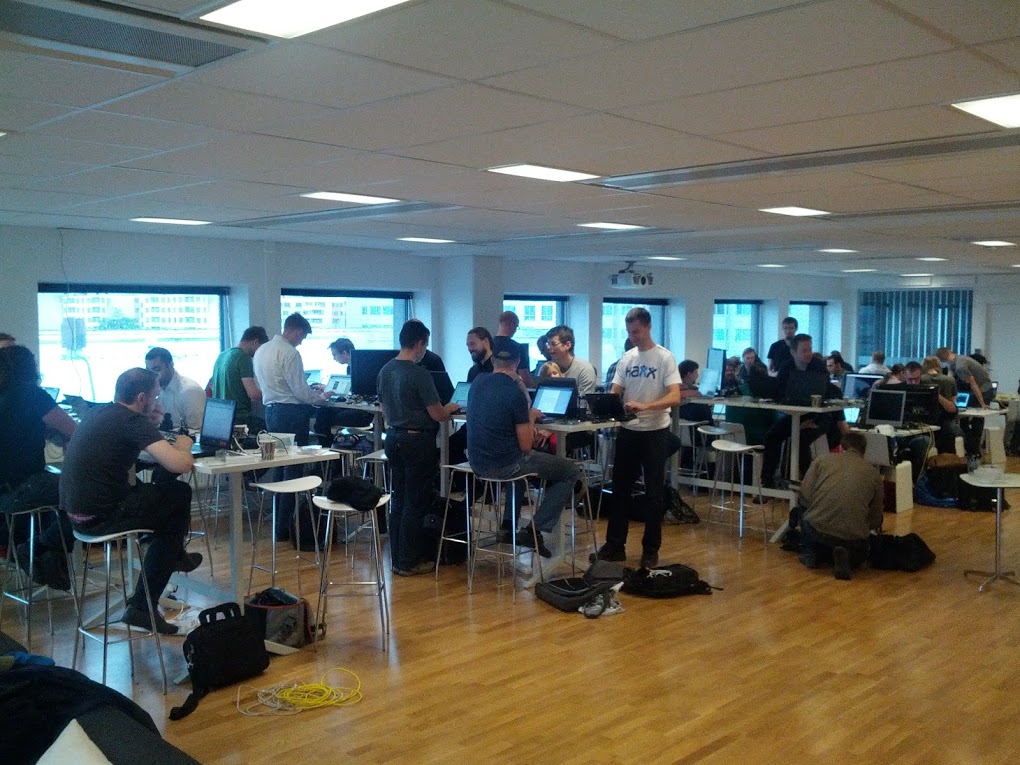
the-roomWe started off the event at 10:00 on October 20 in the Enea offices in Kista, Stockholm Sweden. People dropped in one by one and were handed their welcome present containing a raspberry pi board, a 2GB SD card and a USB-to-serial cable to interface/power the board with. People then found their seats in the room.

There were fruit, candy, water and coffee to start off and keep the mood high. We experienced some initial wifi and internet access problems but luckily we had no less than two dedicated Enea IT support people present and they could swiftly fix the little hiccups that occurred.
coffee machines

Once everyone seemed to have landed, I welcomed everyone and just gave a short overview of what to expect from the day, where the toilets are and so on.

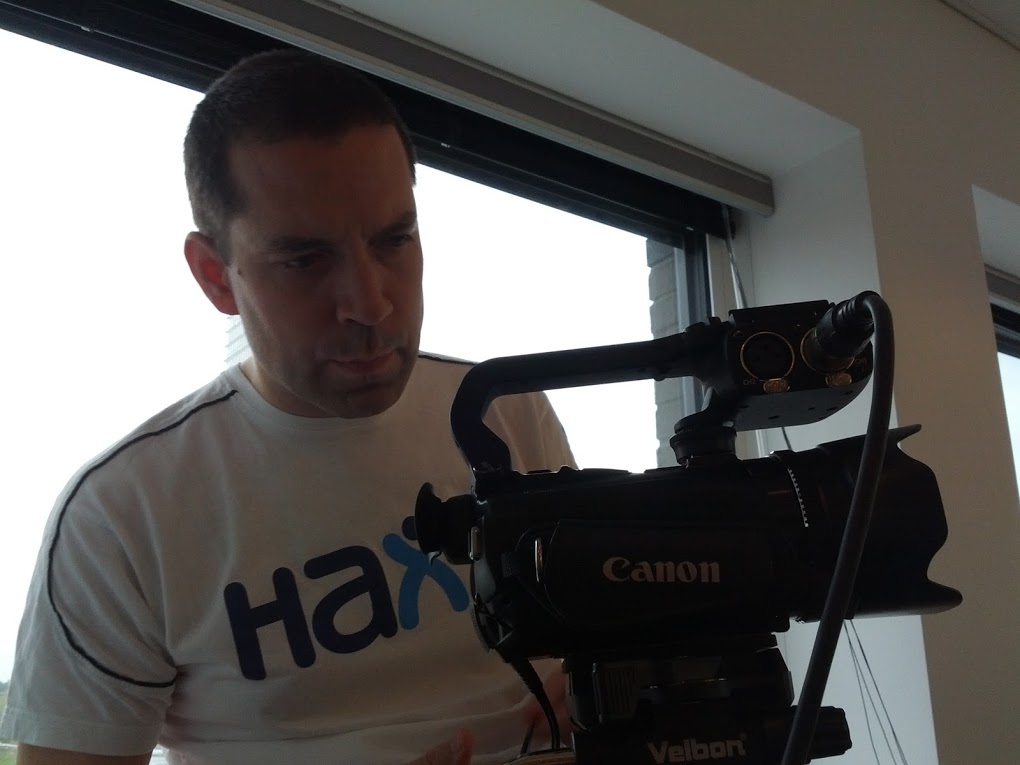
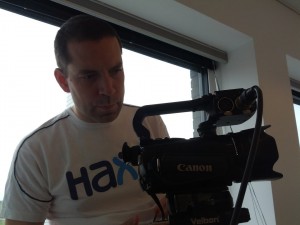
In order to try to please everyone who couldn’t be with us at this event, due to plans or due to simply not having got one of the attractive 40 “tickets”, Björn the cameramanEnea helped us arrange a video camera which we used during the entire day to film all talks and the contest. I can’t promise any delivery time for them but I’ll work on getting them made public as soon as possible. I’ll make a separate blog post when there’s something to see. (All talks were in Swedish!)
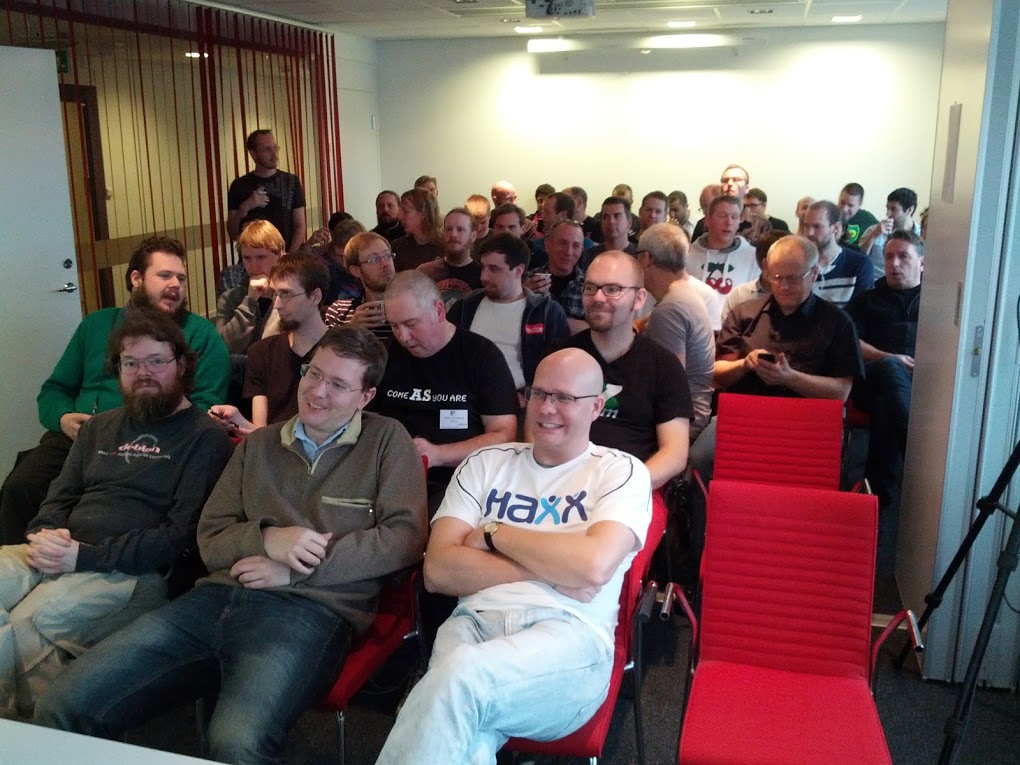
At 11:30 I started off the day for real by holding the first presentation. We used one of the conference rooms for this, just next to the big room where everyone say hacking. This day we had removed all tables and only had chairs in the room movie theater style and it turned out we could fit just about all attendees in the room this way. I think that was good as I think almost everyone sat down to hear and see me:

Open Source in Embedded Systems
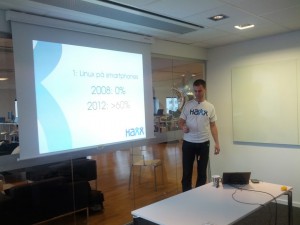
daniel talks open source I did a rather non-technical talk about a couple of trends in the embedded operating systems market and how I see the upcoming future and then some additional numbers etc. The full presentation (with most of the text in Swedish) can be found on slideshare.

I got good questions and I think it turned out an interesting discussion on how things run and work these days.

After my talk (which I of course did longer than planned) we served lunch. Three different sallads, bread and stuff were brought out. Several people approached me to say how they appreciated the food so I must say that Enea managed really well on that account too!

Development and trends in multicore CPUs
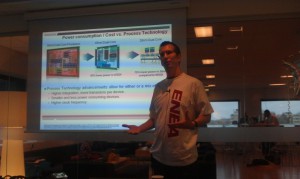
jonas talks about CPUs
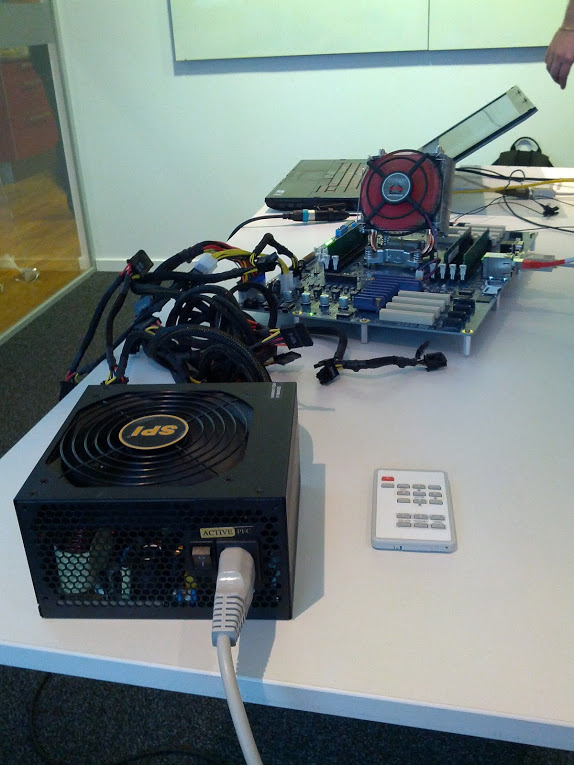
Jonas Svennebring from Freescale was up next and talked about current multicore CPU development trends and what the challenges are for the manufacturers are today. It was a very good and very technical talk and he topped it off by showing off his board with T4240 running, Freecale’s latest flagship chip that is just now about to become available for companies outside of Freescale.
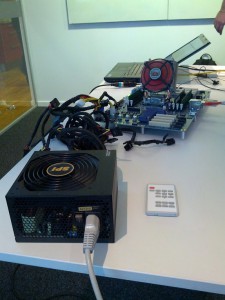
T4240 from FreeescaleOn this photo on the left you see the power supply in the foreground and the ATX board with a huge fan and cooler on top of the actual T4240 chip.

T4240 is claimed to have a new world record in coremark performance, features 12 hyper-threaded ppc cores in up to 1.8GHz.

There were some good questions to Jonas and he delivered good and well thought out answers. Then people walked out in the big room again to continue getting some actual hacking done.

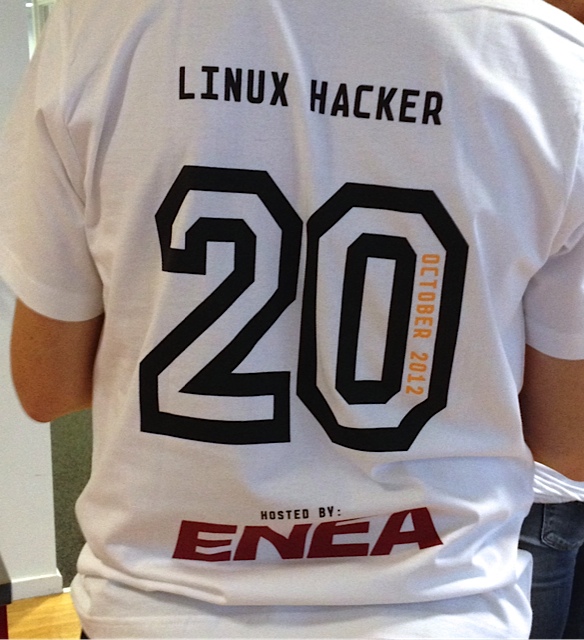
We then took the opportunity to hand out the very nice-looking tshirts to all attendees, again kindly done so by Enea.

The Contest

The next interruption was the contest. Designed entirely by me to allow everyone to participate, even my friends and Enea employees etc. On the photo on the right you can see I now wear the tshirt of the day.
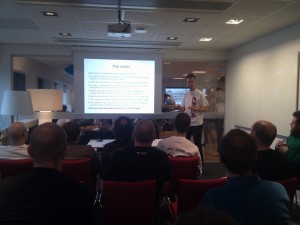
the contest
The contest was hard. I knew it was hard as I wanted it really make it a race that was only for the ones who really get embedded linux and have their brain laid out properly!

I posted the entire contest in separate blog post, but the gist of it was that I presented 16 questions with 3 answer alternatives. Each alternative had a sequence of letters. So after 16 questions you had 16 letter sequences you had to put in the right order to get a 17th question. The first one to give a correct answer to that 17th question would win.

A whole bunch of people gave up immediately but there was a core group who really fought hard, long and bravely and in the end we got a winner. The winner had paired up so the bottle of champagne went jointly to Klas and Jonas. It was a very close call as others were within seconds of figuring it out too.

I think the competition was harder than I thought. Possibly a little too hard…

Your own code on others’ hardware
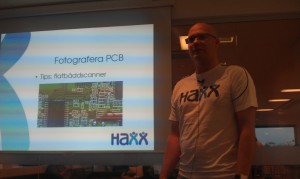
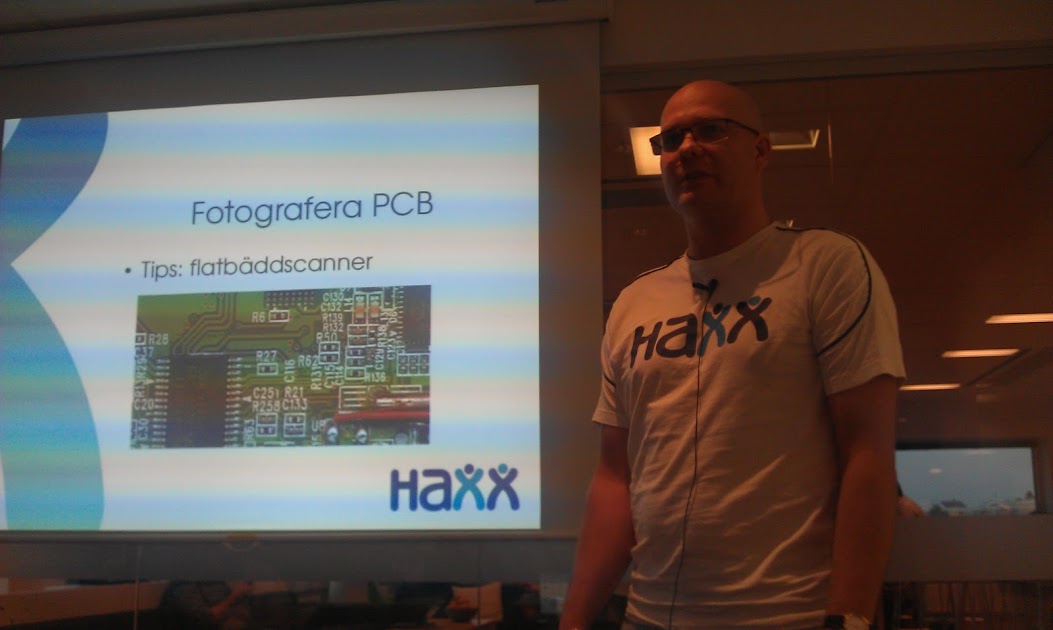
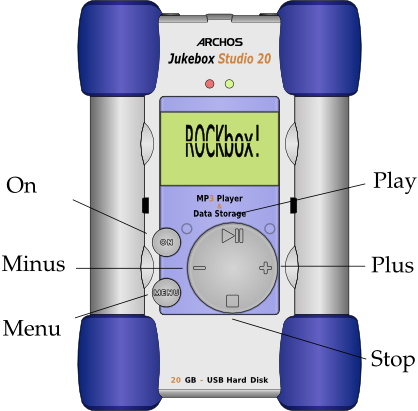
linus talksLinus from Haxx (who shouldn’t be much of a stranger to readers of this blog) then gave some insights on how he reversed engineered mp3 players for the Rockbox project. Reverse engineering is a subject that attracts many people and I believe it has some sort of magic aura around it. Again many good questions and interested people in the room.
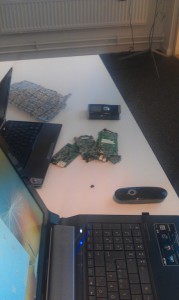
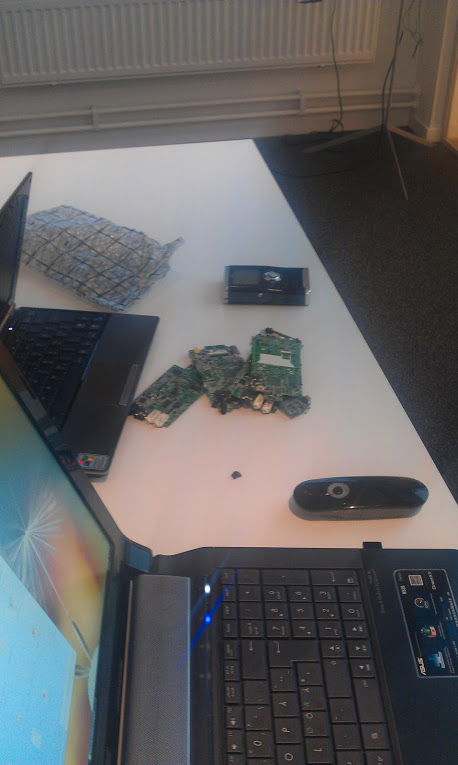
Linus bare targets as seen during his talk On the photo on the right you can see Linus’ stripped down hardware which he explained he had ripped off all components from in order to properly hunt down how things were connected on the PCB.

Coffee

We did not keep the time schedule so we had to get the coffee break in after Linus, and there were buns and so on.

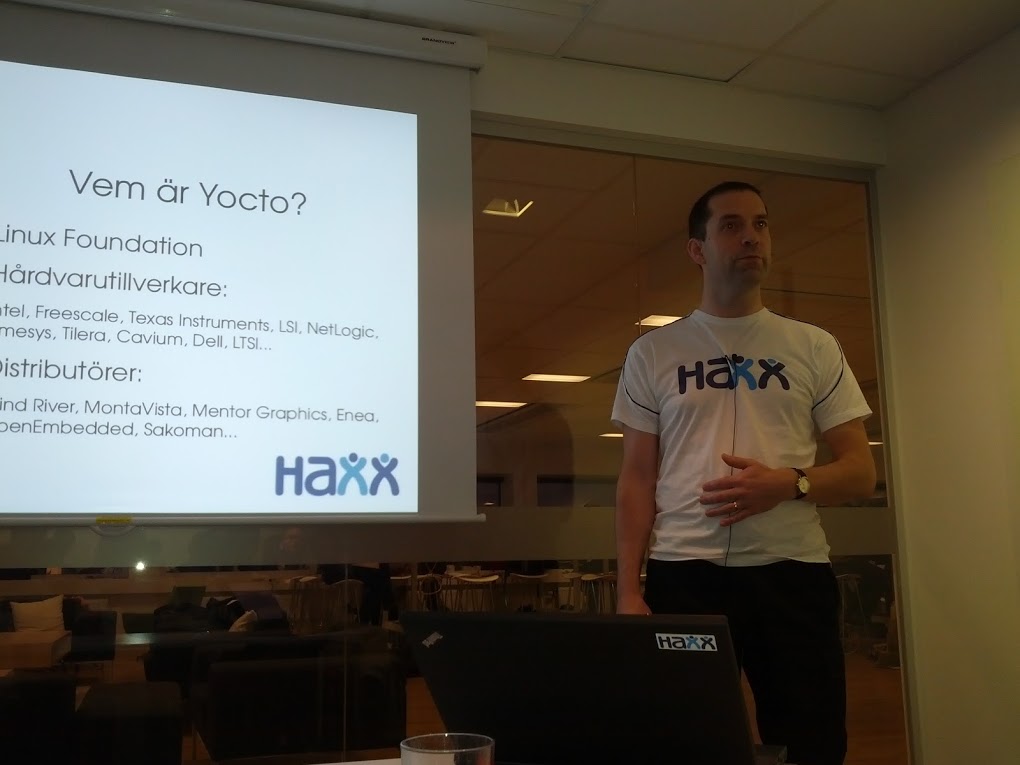
Yocto

Björn from Haxx then educated the room on the Yocto Project. What it is, why it is, who it is and a little about how it is designed and how it works etc.
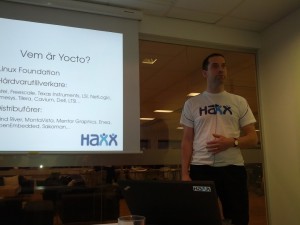
bjorn talks on yocto

I think perhaps people started to get a little soft in their brain as we had now blasted through all but one of the talks, and as a speaker finale we had Henrik…

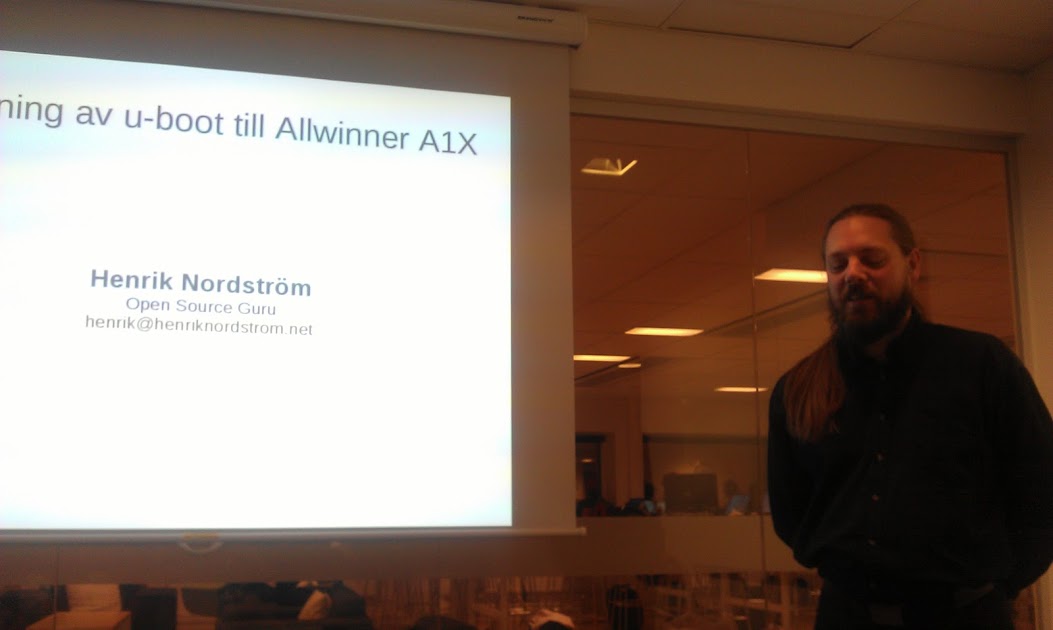
u-boot on Allwinner A10

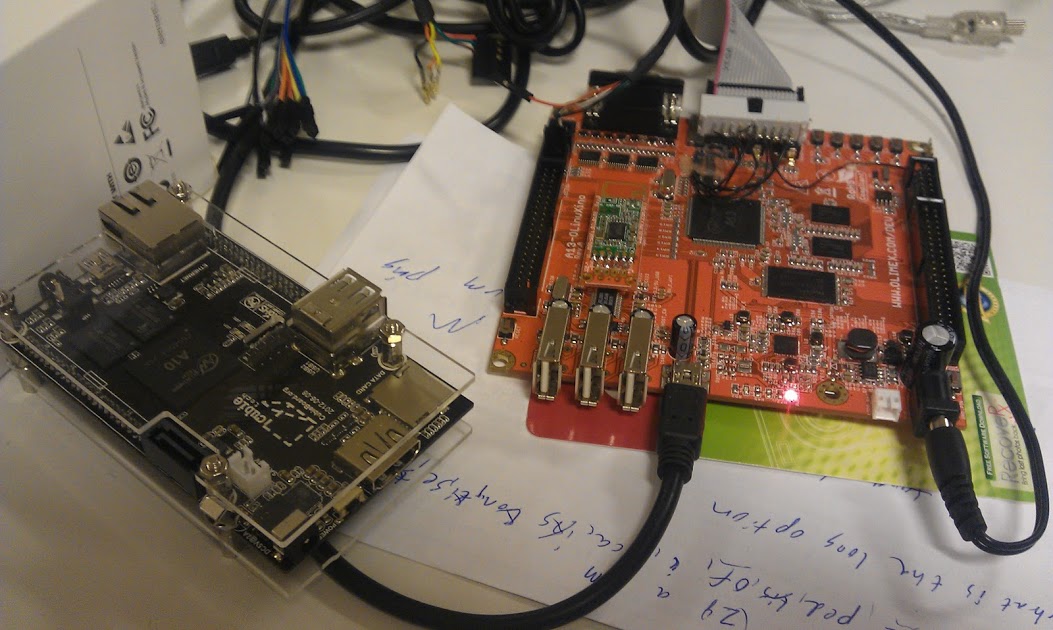
Henrik Nordström did a walk-through explaining some u-boot basics and then explained what he had done for the Allwinner targets and related info.
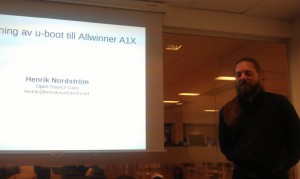
Henrik talks u-boot
I believe the talks were kind of the glue that made people stick around. Once Henrik was done and there was no more talks planned for the day, it was obvious that it was sort of the signal for people to start calling it a day even though there was still over one hour left until the official end time (20:00).
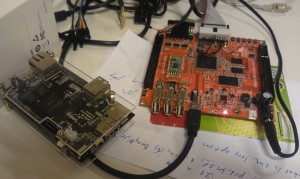
Henriks hardware
Of course I don’t blame anyone for that. I had hardly had any time myself to sit down or do anything relaxing during the day so I was kind of exhausted myself…

Summary

I got a lot of very positive comments from people when they left the facilities with big smiles on their faces, asking for more of these sorts of events in the future.
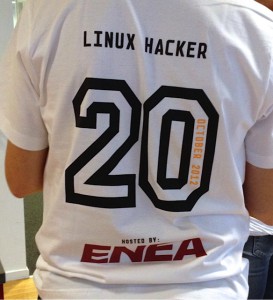
The back of the Enea tshirtI am very happy with the overly positive response, with the massive interest from our community to come to such an event and again, Enea was an awesome sponsor for this.
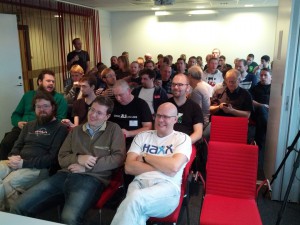
Talk audienceI didn’t get anything done on the raspberry pi during this day. As a matter of fact I never even got around to booting my board, but I figure that wasn’t a top priority for me this day.

The crowd size felt really perfect for these facilities and 40 something also still keeps the spirit of familiarity and it doesn’t feel like a “big” event or so.

Will I work on making another event similar to this again? Sure. It might not happen immediately, but I don’t see why it can’t be made again under similar circumstances.

Credits
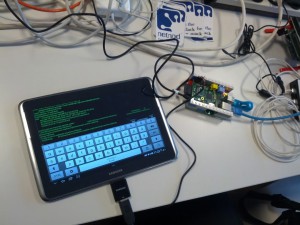
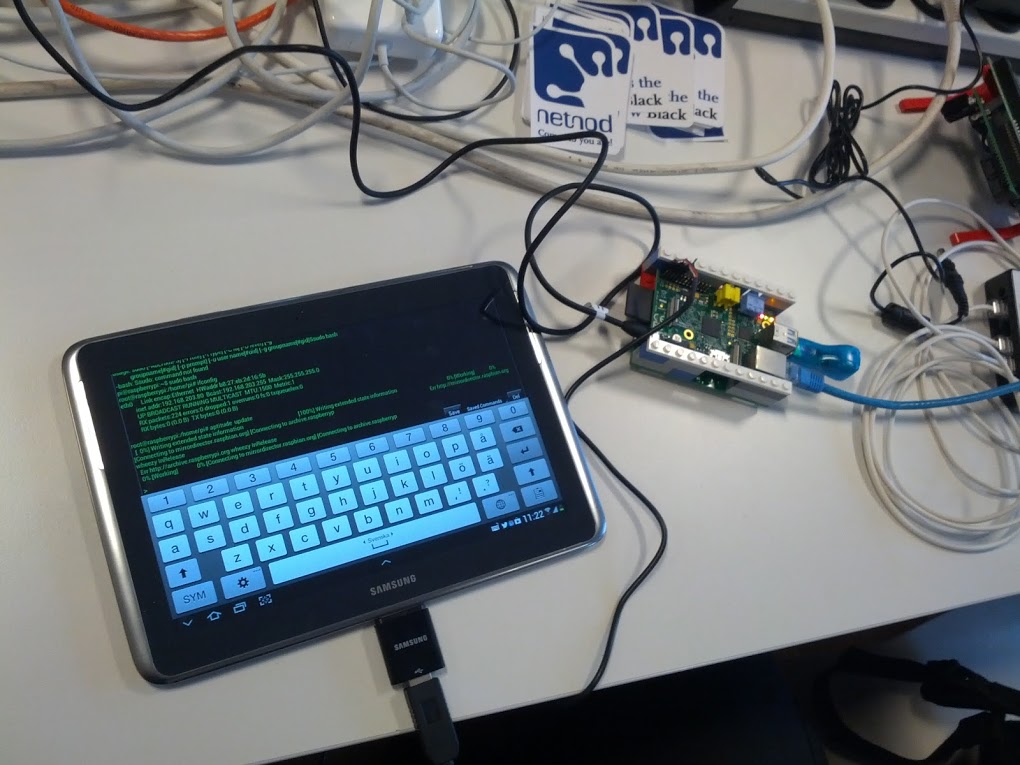
rpi accessed with tabletAll photos on this page were taken by me, Björn Stenberg, Kjell Ericson, Mats Lidell and Mia Åkerström.

Thanks to Jonas, Björn, Linus and Henrik for awesome talks.

Thanks to Enea for sponsoring this event, and Mia then in particular for being a good organizer.

No summer of Rockbox 2012

Sunday, March 18th, 2012

For the first summer in many years I’m not doing any admin or mentor work for an organization for Google’s Summer of Code program this year.

I’ve been mentoring, co-mentoring and admined within the Rockbox project the last… 4-5(?) summers and as a result I now have a good collection of t-shirts. :-) This year, the project sadly came to the conclusion that there was not a good enough number of mentors and projects ideas gathered for it to apply to become a mentor organization.

Taking care of a student for full-time work during many weeks is not something to take lightly. To do it properly you need a dedicated and qualified mentor. To provide a good starting point for students to figure out and come up with a good project proposal you need an really good and detailed list of ideas.

The gsoc task is hard enough as it is with many mentors and many good ideas, so when there’s a sign of us not being able to fill up both lists we thought it better not to waste anyone’s’ time or energy. We also value and treasure Google’s very fine help with open source over the years thanks to gsoc, and we would hate to end up looking like we try to just take advantage of our role of having been accepted as mentor organization for many years in a row in the past.

In the other end, I was very happy to see that my friends in the metalink project finally after having applied many years got accepted as a mentor organization. I’d like to think that perhaps we (as in the Rockbox project) by standing back this year can let others get the chance to shine and join in the fun.

There is nothing said or planned for Rockbox for next year. If people want to mentor and if we manage to get a good pile of ideas I’m sure we will apply to be a mentor organization again. If not, well then I’m sure other organizations will still participate in the program and possibly I will find myself involved in there via another project. I am involved in a bunch of other open source projects, but none of the ones I’m very active in have applied nor participated as mentor org in gsoc so far.

I’m interviewed by foss-magasin

Sunday, December 11th, 2011

foss-magasin

Claes at foss-magasin.se asked a bunch of questions about me, my commitments within the FOSS community and related matters recently over email. This Swedish interview just now went public: Daniel Stenberg – cURL, Rockbox och FOSS-Sthlm.

For my international friends who don’t understand the Swedish: I am quite happy with the questions and being allowed to answer them at this lengths etc, so I am considering doing a full translation of it and posting it at a later date.

Ten years of Rockbox

Wednesday, December 7th, 2011

In december 2001 the mailing list was setup and the first mail was sent out on December 7th. This was months before the project had any name. We just gathered eager reverse-engineers wanting to improve the Archos Player firmware.

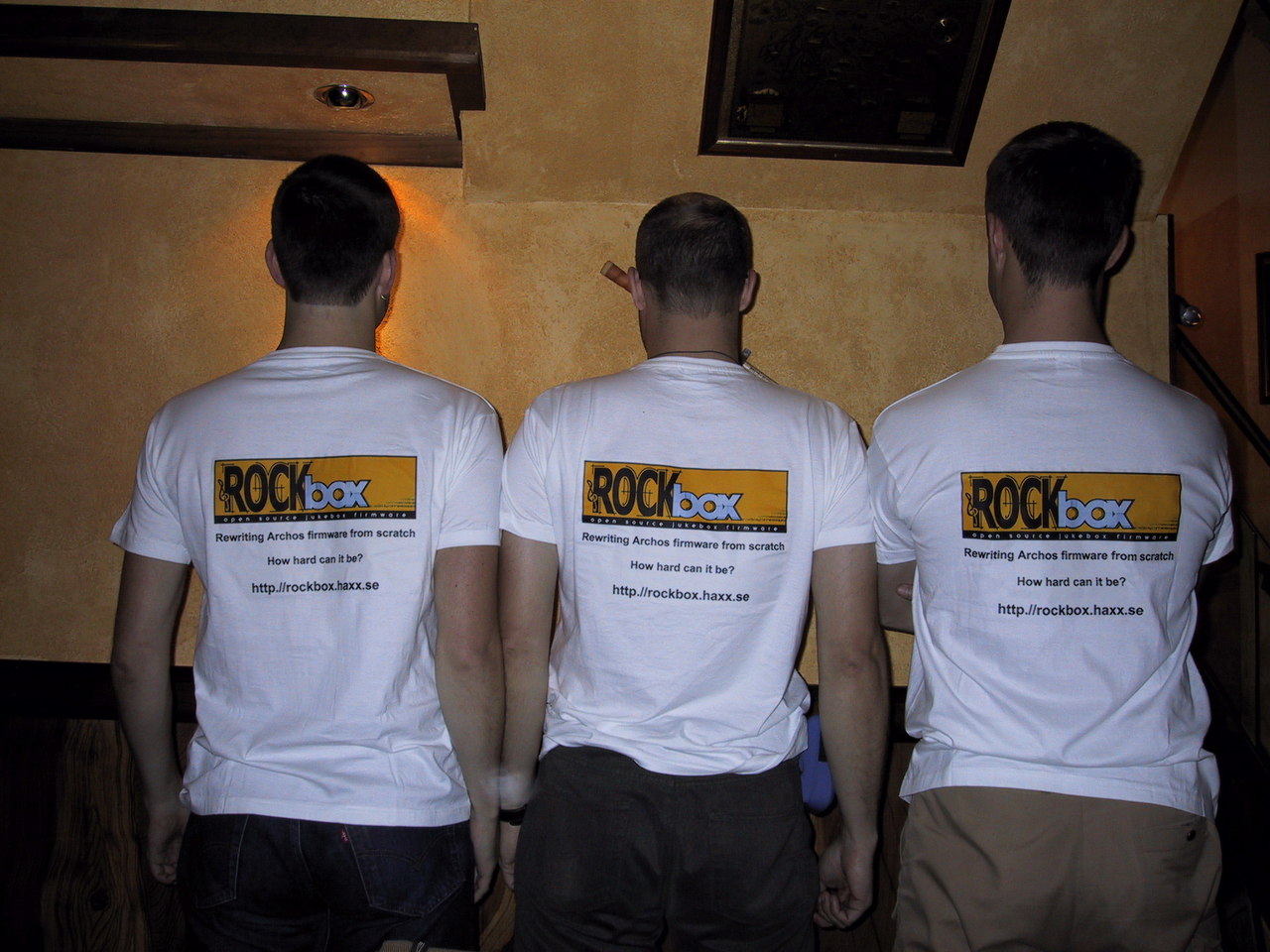
We were just a few friends who like hacking low level code, both as professionals but also in our spare time – and we really thought that these kinds of devices had much larger potential than what the firmwares they were given allowed them. “Rewriting Archos firmware from scratch, how hard can it be?” as we used to joke. Oh well, we did.

archosplayer-front

From that moment we worked on mp3 players. A couple of months later we started on the next target (Archos Recorder) and so we continued. We got ourselves the name Rockbox for the project and people joined up from everywhere, wanting to contribute their knowledge and enthusiasm.

Rewriting Archos firmware from scratch - the tshirts

(Björn “Zagor” Stenberg, Linus “LinusN” Nielsen Feltzing and Daniel “Bagder” Stenberg in September 2002.)

We got our logo in 2002. In 2003 we supported the FM recorder model. We ported code to and run our first stuff on a “software codec” target in 2004. During 2005 we added support for our first color screen targets and in 2006 we added ipod to our “family”. The flood gates opened and new targets have poured in ever since. iAudio X5 and the Sansa e200 were also added that year.

Today, we have code running natively on 75 something targets (on SH1, m68k, ARM and MIPS architectures) and we run Rockbox as an app on top of other operating systems such as Android and Maemo. The project keeps up a fast pace and even in the last few months we’ve seen several new ports having been added to the source code tree.

Being a large project with lots of strong personalities and committed developers we’ve had our share of politics and flame fests. The real name policy was originally a reason for lots of heated debates, as we only accept contributions from people who provide real names – no nick names, but as time has passed the arguments have more and more been over technical details or over how the development is or isn’t run.

Rockbox has participated in the Google summer of Code program four years as a mentor organization and in this time we’ve had perhaps 15 students that have worked on Rockbox, and a bunch of them were successful and a fair amount of those students stayed in the project after having finished their summer projects.

The Android version hasn’t been released on the Android market so far because lots of developers think that first impressions is very important and as Rockbox has been designed with fixed-size screens there has been no support for platforms with varying screen resolutions. This has forced Rockbox to provide different versions for different Android targets (screens really). In addition to that, the GUI of Rockbox has been all native Rockbox and not very Android-like which has also been mentioned as a con. These issues are being worked on, although I cannot provide any estimate for when we’ll see Rockbox “for real” on Android.

I’ll stick to my story about what I think of Rockbox’s future: I think the dedicated music player market is going away slowly and that phones and other portable devices is what people will use to play music on. Rockbox is a very capable music player, but the question is if there’s really a demand for it on the new generation of devices…

Rockbox Steering again

Sunday, October 23rd, 2011

I’m proud and happy to once again having been voted into the Rockbox Steering Board. Thanks for your trust and confidence in me, friends! I’m hereby starting my 4th season in this role, which also happens to be all years the RSB has existed.

The RSB has really only had to act once. I don’t foresee any drastic change in this regard this year. The complete board consists of:

Alex Parker
Björn Stenberg
Daniel Stenberg
Frank Gevaerts
Jens Arnold

Rockbox

The gsoc 2011 tshirt

Saturday, October 22nd, 2011

I served as Google Summer of Code admin this year again, doing as little as possible, for the Rockbox project.

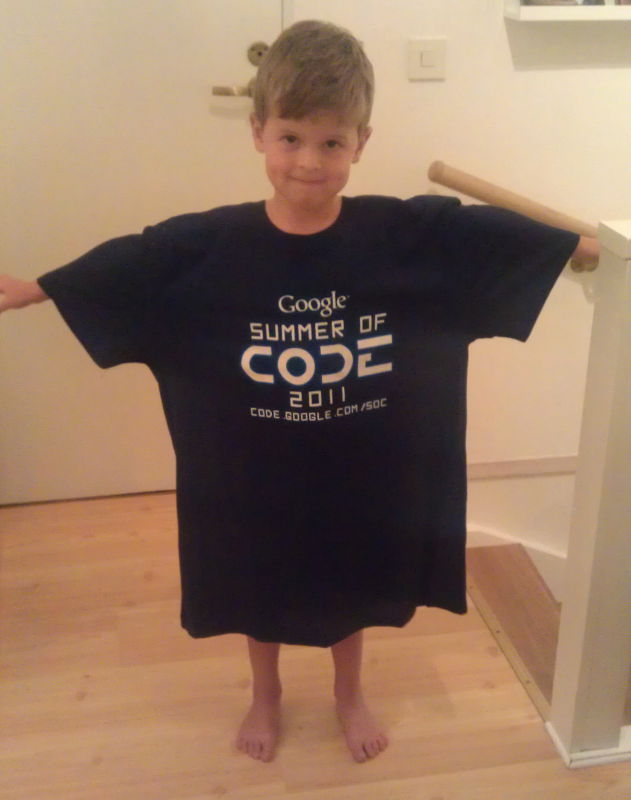
As usual, us volunteers are given a tshirt for our efforts and this year’s version looks like shown below. My son Rex was very happy to do the modeling, even though I think the size is slightly too big for him…

The GSOC 2011 shirt

Haxx, the second year

Sunday, September 18th, 2011

Last year I posted my report of what I and my fellows did at Haxx after the first year of true and real independence. As I probably mentioned before, we registered our company 1997 but it was just a side project for over a decade.Haxx logo

Now, when we’re slowly approaching two years it is time to look back and what we’ve done during the past twelve months and what we’re doing right now.

We have firmly established ourselves even more as expert developers within embedded systems. We’re over and over again being hired by the teams that themselves are hired by companies to provide services or products. During the last twelve months, we’ve written software and software designs for a huge medical equipment company, a small video equipment manufacturer, a major international telecom, a market-leading embedded systems provider and a global chip manufacturer. We’ve debugged simulation software, designed video streaming servers, done video subtitling magic, poked on Linux kernel code and we’ve done old-school 8051 and 16bit x86 assembly. I’ve also managed to do a Embedded Linux development (in user-space) training course – twice. All this, in just the past year!

Haxx was (and presented) at FSCONS in Gothenburg, we went to (and presented at) FOSDEM in Brussels and we went to the Rockbox devcon in London. We did lots of work within the foss-sthlm community.

Oh, and we’ve revamped our logo and graphical design.

Haxx consists of three full-time employed senior expert embedded systems consultants. We’ve all been in the industry for over twenty years: Daniel Stenberg, Björn Stenberg and Linus Nielsen Feltzing.

We continuously work with partners in the area to reach out to new and existing customers. As we’re very small and rather spend our time on working in our actual assignments we appreciate the help with sales and marketing. If you’re in the Stockholm area and ever end up needing devoted and skilled embedded software hackers, call us!

I’m gonna do my very best to make sure we get another great year! I’ll report back and tell you how it went.

Rockbox Devcon 2011

Sunday, June 5th, 2011

Rockbox

Hoards of hackers in similar-looking t-shirts with funny logos having the b in front of the K (see below for some sort of explanation) were seen on the streets of London on Friday June 3rd 2011.

Thanks a lot to  Google UK who hosted our Rockbox developers conference this time in central London.

We had some short-time visitors but we were 16-18 reverse engineering happy persons in a single room most of the weekend, where we hacked away on code, whined on the amount of outstanding patches and bugs and generally made a large amount of bad jokes and Monthy Python references.

The happy core team was caught on a picture:

Rockbox team Devcon 2011

On the Saturday we plowed through a lengthy list of discussion points to really make the most of all of us gathering physically. Among the outcomes from that is that we decided we want to change to git, we think a lot of future of Rockbox lies in the app for Android, we keep the Archos support and more. The Android builds are going to get into the build system ASAP and we’re gonna setup a system where (only) trusted build clients will participate in the building of Android builds that will be distributed to users – this since applications on phones will have a much greater risk of causing harm if some “bad guy” would try to infect our system with stupid things.

Dominik “bluebrother” Riebling brought up the very interesting point that none of us had noticed: we have two different logos being used in the project: one with the K being in front of the b (like the one on the web page) and one with the K being behind the b – which is used in SVG logos and on just about all Rockbox t-shirts made so far! If you zoom in on the tshirts on the group picture you’ll see!

We will also start allowing GPLv3 code into Rockbox in order to be able to use espeak, but all our code will remain GPLv2 or later. I could only find a single USB header file left that comes from the Linux source tree and has a GPLv2 only license.

Even more than this was discussed but I figure the rest of the details will be posted properly on rockbox.org for those seriously interested.

All in all, it was a very enjoyable weekend with a lot of fun and great friends. We stayed at a hotel just a few blocks from the devcon office which was really convenient. even though its wakeup routine was a bit non-standard. Peter “petur” D’Hoye took a lot of pictures as usual.

We also managed to break the Tower of Rockbox record.

Daniel "Bagder" Stenberg Rockbox Devcon 2011

The group picture was taken by a Google person I don’t know the name of who helped us out, and the one of me was taken by Peter D’Hoye.

Rockbox bridge and tower

Sunday, June 5th, 2011

Keeping to the tradition and subtle arts of Rockbox Towers, but doing it with a twist to celebrate the place we have Rockbox devcon 2011, we decided to make a Rockbox bridge.

We started out by gathering all devices we had in the room that can run Rockbox and distributed them on the construction floor area. As the Android app runs fine on tablets now there’s actually a rather good way to get some solid base into the construction…

Many Rockbox devices

Once all material was known, the construction started with a large amount of eager engineers contributing with good and bad ideas and at times very shaky hands:

constructing a Rockbox bridge

(wods, scorche, gevaerts and paumary)

The result, involving an iRiver beneath the bridge catching the digital flow, became what might be the longest Rockbox construction done so far:

Rockbox bridge

Rockbox bridge closeup

After the bridge, the work started on the real stuff. Building the tallest Rockbox tower ever made. After a couple of accidents and crashes, the tireless team managed to break the previous 104 cm record and the new Rockbox tower record is now officially 117cm:

Rockbox devcon 2011 tower 117cm

(Pictures in this post were all taken by Peter D’Hoye.)