
curl and libcurl are written in C. Rather low level components present in many software systems.
They are typically not part of any ecosystem at all. They’re just a tool and a library.
In lots of places on the web when you mention an Open Source project, you will also get the option to mention in which ecosystem it belongs. npm, go, rust, python etc. There are easily at least a dozen well-known and large ecosystems. curl is not part of any of those.
Recently there’s been a push for PURLs (Package URLs), for example when describing your specific package in a CVE. A package URL only works when the component is part of an ecosystem. curl is not. We can’t specify curl or libcurl using a PURL.
SBOM generators and related scanners use package managers to generate lists of used components and their dependencies. This makes these tools quite frequently just miss and ignore libcurl. It’s not listed by the package managers. It’s just in there, ready to be used. Like magic.
It is similarly hard for these tools to figure out that curl in turn also depends and uses other libraries. At build-time you select which – but as we in the curl project primarily just ships tarballs with source code we cannot tell anyone what dependencies their builds have. The additional libraries libcurl itself uses are all similarly outside of the standard ecosystems.
Part of the explanation for this is also that libcurl and curl are often shipped bundled with the operating system many times, or sometimes perceived to be part of the OS.
Most graphs, SBOM tools and dependency trackers therefore stop at the binding or system that uses curl or libcurl, but without including curl or libcurl. The layer above so to speak. This makes it hard to figure out exactly how many components and how much software is depending on libcurl.
A perfect way to illustrate the problem is to check GitHub and see how many among its vast collection of many millions of repositories that depend on curl. After all, curl is installed in some thirty billion installations, so clearly it used a lot. (Most of them being libcurl of course.)
It lists one dependency for curl.
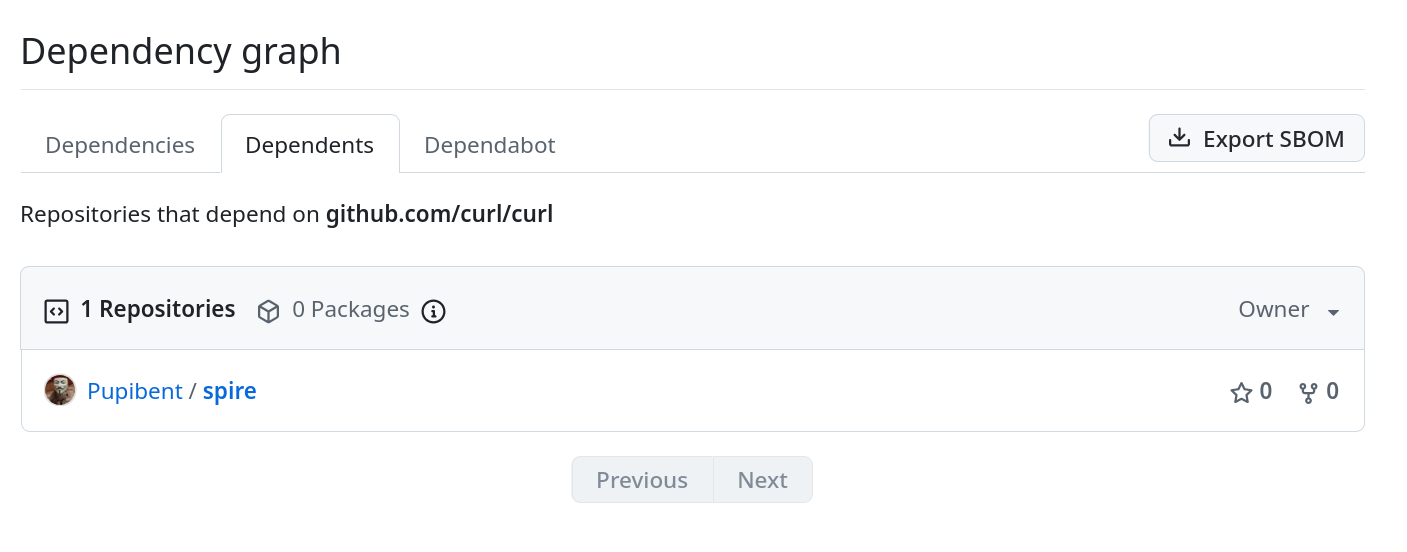
What makes this even more amusing is that it looks like this single dependent repository (Pupibent/spire) lists curl as a dependency by mistake.
https://github.com/Pupibent/spire/blob/0a6bfb1b569e308234428a76f95e3c912ca537db/go.mod#L8
🙂
`go.mod` files with random inaccurate dependencies in random repositories seems to be a thing.
This monstrosity is the only file in this repo, for example: https://github.com/flushedface/look-at-my-profile/blob/master/go.mod
guix graph curl
Will provide full dependency graph up to minimal binary seed
https://guix.gnu.org/en/blog/2023/the-full-source-bootstrap-building-from-source-all-the-way-down/
Nixpkgs are amazing for that reason. The semantics enable tracking every input and distinguishing build dependencies from prod.
Vendoring defeats the amazingness of Nixpkgs a little. With CVE-2023-4863, contributors had to painstakingly go through packages to find and update vendored copies of libwebp because there was no way to track it or update it centrally.
https://github.com/NixOS/nixpkgs/issues/254798
https://archive.fosdem.org/2024/events/attachments/fosdem-2024-1983-remediating-thousands-of-untracked-security-vulnerabilities-in-nixpkgs/slides/22601/Remediating_1000s_of_untracked_vulnerabilities_yS8r8je.pdf
I would argue that curl is absolutely part of an ecosystem, the C ecosystem. The fact that the C ecosystem is such a huge mess that it is barely recognizable as an ecosystem is part of the problem here.