Category Archives: Technology

Really everything related to technology

Manufacturers Hate Customers

I’ve been involved in the Rockbox project since before it was named Rockbox and in fact long before the first code as written. I’ve contributed to it pretty much over the years and I have a fair insight in how most of the ports have been made and what efforts that are behind them. Today, Rockbox runs on around 25 different digital music players.

The first ports of Rockbox was (in retrospect) rather easy since we took it to architectures what were made with circuits and chips for which we could find documentation online.

Recently, music players as well as other consumer electronics are being made using products and circuits from companies that blatantly refuse to hand out documentation. Companies such as PortalPlayer (now Nvidia), Austrian Micro Systems, Samsung, ALI, NEC, Broadcom, Telechip, Texas Instruments, Sigmatel (to name a few) all make interesting and fun hardware but…

Let’s say I am looking into alternatives when creating new hardware. I want to build something new and cool. Something not done before, that would be portable and feature sound and an LCD and whatnot. I see what cool manufacturers there are out there and I can read their propaganda on their fancy web sites. So, I want to compare company A’s fancy chip with company B’s. I contact them in order to get to know as much as possible to be able to compare these beauties.

Data Sheet for a technical thing

No, you cannot get any docs. We will not tell you how our products are used until you sign up for a huge contract. These companies don’t only require NDAs to be signed and similar, they simply won’t let you get the docs no matter what if you’re a small player and are just interested in comparing and evaluating products.

I’ve contacted several companies with this purpose in mind. I work with embedded products for companies doing products using such chips, so I would assume I should be the kind of person these companies would respond to with an open mind and a will to sell me their stuff. But they clearly hate customers.

This problem is of course also tightly related with the eternal discussion of manufacturers not wanting to hand out docs to hardware they sell for PCs, such as graphic cards (AMD/ATI, Nvidia, etc) and network cards (Broadcom, etc). These companies usually hide behind a blurry statement about protecting their intellectual property and being afraid of ending up in the hands of the competition but that always and unconditionally end up with the arguments:

  • The competitors can get this info anyway by simply acting like a big customer, or possibly by buying the info from an existing customer. This protection only hides the info from the little people, not from the big guys with resources.
  • Getting information from the hardware based on a detailed description on how to use it is quite frankly a very ineffective way of cloning someone else’s design and not a likely scenario.
  • Development in these areas is at such a high speed these days, so getting the docs for the current hardware give hardly any competitive edge since the mere operation of copying it to make an own version of it takes a long time and by the time it would be done it would already be outdated.

I sometimes wonder if the chip manufacturers do this on demand from their bigger customers, the consumer electronics companies, to help them keep things hidden so that we – the general public – will have a harder time to modify and/or reverse engineer their products, which may lead to additional support issues for them.

We see this development of secret-docs going in the wrong direction. Samsung used to publish a lot of docs for their ARM-core based microcontrollers, but they no longer do so. Marvell bought the Xscale family from Intel and recently they took away all the public docs for them…

We see “open source” projects (like Neuros uses TI chips) go with these companies so that they can’t reveal all source code.nvidia chip

Luckily, not everything is darkness. There are occasional bright spots, as the other day when AMD announced their intention of bringing their open source ATI drivers up to speed with what could be expected of them..

So what is there to do about this? What can we “little people” do to change these big evil corporations? There’s really only one way: put the money where the docs is! Buy stuff from the good companies. Recommend your clients to release docs openly. Recommend your clients to buy hardware (parts) from companies that host their documentation publicly.

Break Out Of That Proxy

SSH proxy functionality overview

Far too often we end up behind a proxy that limits our network access in one or more ways. There are however clever ways that in most cases allow us to work around the nuisances the proxies impose, and I’ve written down my “guide” on how to do it here!

This is a procedure I’ve used myself many times and I’ve ended up explaining it to others several times as well so I felt it was about time I wrote it down.

I’ve tried to catch most quirks and be detailed and accurate, but please point out if you find any errors or mistakes in there. I hope to be able to perhaps add more specific config examples and command lines as well to make it even easier to follow.

Full-Screen is Hip

iPod Touch

Clearly the major electronic device companies are starting to really like full-screen touch displays for their phones and media devices, and we see them coming from all directions now:

Apple’s iPhone, and its sibling the recently announced ipod Touch, the Nokia concept phone, LD prada, HTC touch, Creative Zen “touch” and I bet we’ll soon see more from other manufacturers following. Like Samsung, Philips, Sony Ericsson and the likes…

We’ve seen devices like Arhos 604 and the Acer MP-500 before but I think what we see now with Apple’s iphone lead is the final step of the ladder and all the prime companies follow suit.

Plenty Pointless Printer Processes

I recently got a new printer for my home network. My old Epson Photo 870 printer with a D-Link Ethernet-to-parallel port printer server thing suddenly died one day not too long ago.

HP Photosmart C6180I opted for a solution with native Ethernet support that could also work as a copier and scanner so that those (even though rather rarely needed) functions would also be dealt with nicely. (In fact fax too, but I can’t think I’ll ever use that so I haven’t bothered to connect it to the phone system.) I went with the HP C6180 thing, since seemed like a nice setup for a fairly low price. Even though I don’t necessarily plan to print to it from my Linux hosts, I did read some positive reviews about it when used from Linux with CUPS so that was another point talking for this particular model. The printer even has wifi support but I’m using wired Ethernet since it is faster and I have the printer standing next to my wifi router anyway. Also, having scanner supported would mean I can finally put away my 7 year old USB scanner that I’ve been lugging out to use on occasion.

Sometimes (or is it often?) we get to hear that the printer situation on Linux is horrible or at least far from perfect, and while I agree with that I find the situation on Windows horrible – but for entirely different reasons

I followed the printer’s user manual on how to install it on Anja‘s (my wife’s) laptop that runs Windows XP, by inserting the CD and clicking “yes – over Ethernet” etc and it went on and and installed. And wow, did it get installed!

It brought four new icons to the desktop and after the lengthy process was at the end there were at least ten new processes running in the system and for some reason they actually made an impact and the system felt slower! I had to go on a kill frenzy to clear up the worst mess. The amazing part is that even though I killed every single process starting with “HP”, everything still worked exactly like I wanted. And with “msconfig” I could also prevent some of the worst stuff to start again at next reboot… (This kind of behavior is sadly not specific for printers-only on Windows…)

I did have some initial quirks with the printer, until I set it to use a fixed IP address. I’m not sure it really had something to do with it, but I wanted fixed IP anyway and the problems seemed to vanish.

Sony Ericsson w580i on Windows

Sony Ericsson w580iI have a fairly new phone, the Sony Ericsson w580i and I think it is a neat little thing.

I’ve been using it as a usb-storage device at home under Linux without any problems, and I’ve pretty much filled my extra 4GB M2 card with music from my collection.

Today I decided to try to get a picture from my phone to my work PC (which is running… eh, Windows XP) and guess if I’m up to a shock: it doesn’t talk to the phone. It claims it can’t find any drivers for it and for some reason it doesn’t just go for usb-storage (even though we know now that it is OHCI compatible – at least).

Crap. On the Sony Ericsson site they offer the Sony Ericsson PC Suite 2.10.38 (for Windows Vista/XP) which is a whopping 44.8 megabytes! And all I want is to access my phone as UMS. Grrrr.

Once installed, I can access the phone fine but now I get that bonus popup annoyance windows that repeatedly asks me if I want to reboot the computer so that the new stuff can take effect…

LED displays, part II

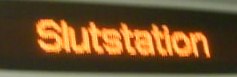
Yes, I got to see the character problem several times more (on bus 178 and 670) after my previous LED display post, and I also got it confirmed by friends who saw it on other buses. It hadn’t been fixed, but clearly the displays in some buses show the correct letters.

pålsundsvägen on display, august 31 2007 17:22 on the 670 bus

I contacted some friends I know have some connections on the bus company, and according to “BL” all systems are supposed to be fixed and should display the letters correctly… He did say that he has forwarded my question onwards so hopefully we’ll get some further updates on this soon.

I got a nice quote forwarded from BL about this and it says that this is a failed installation by the techies that installed the sign on these buses. He (the person who wrote what BL forwarded) also said that if there appears “single buses” with this failure still present he wants to know the bus number to be able to fix…

So, if you read this and get to see the dreaded ü-letter on a bus, take a note on the bus number and time (and I believe the “vagnnummer” – the unique vehicle number printed on the outside of the bus) and report it. You can just post a comment to this entry if you can’t find a better place to post it.

(BTW, the photo is taken with my w580i phone and darn is it hard to take photos in the bus. When the bus finally stops at this particular stop, the sign switches text to the end station name so I could only take photos of the sign while driving…)

LED letters on buses

This week, me and my family have rented a house in the Stockholm archipelago and I’ve been commuting back and forth to work using buses I don’t normally go with (670 and 603 to be precise).

In many of the Stockholm buses there’s a rather big LED-display situated in the ceiling in the front and often somewhere in the middle of the bus, normally displaying the route number and end station and at each stop it displays the name of it while a recorded voice reads out the name of the stop in the speaker system.

While sitting there I noticed how it would display “Pülsundsvägen” instead of “PÃ¥lsundsvägen” (that is with a German letter ü instead of the Swedish letter Ã¥) but I didn’t think much more of it then.

LED display

Another day I happened to go with a complete different bus through a different area and yet again I noticed how the display used the ü instead of Ã¥ while the recorded voice used the letter Ã¥ and I was convinced someone in the bus company must’ve bought a German system or similar and very strangely got satisfied with this very strange-looking graphical choice of letters. The fact that ü was chosen is funny, since we’re kind of used to simply use a in Sweden when Ã¥ isn’t available. I also find it funny that so few people seem to mind.

This morning on the bus when I decided to mention my recent findings to a friend, I was shocked… now this bus actually showed Ã¥ just like it should.

This makes me so puzzled. Was I only dreaming? Do they use different displays/drivers in different buses? Did they do a software upgrade exactly this week that is removing this flaw?