Tag Archives: Open Source

Living With Open Source

.SEAs a session during the Internetdagarna conference (orginized by .SE), Björn Stenberg, Daniel Melin and I joined up to talk about open source with the title “Living With Open Source” (“Att Leva med Öppen Källkod” in the language of the brave: Swedish) on October 27. We did a 90 minute session split up between the three of us. The session was in Swedish and it was recorded so I expect that it will be made available online soon for those who are curious but didn’t attend.
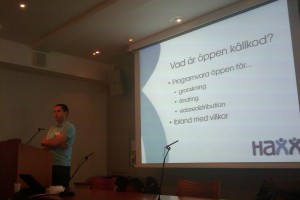
Bjorn Stenberg during "att leva med Öppen kallkod"

Björn (on the picture above) started off by talking about how to work with Open Source as a user when using Open Source components. How to deal with changes, sending upstream, the cost of keeping changes private etc.
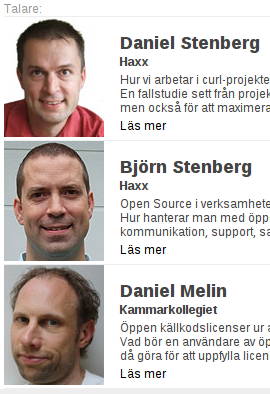
Talare - Att leva med öppen källkodDaniel Melin continued and talked about open source licensing. It is quite clearly an area that people find tricky and mysterious, judging from the many questions that followed. I think large parts of the audience wasn’t very advanced or well versed into open source details so then of course there is a lot to learn and to talk about. I think we all felt that we tried to cover quite a lot that together with the questions was hard to fit within the given time.

I ended our triplet by talking about open source from a producer’s viewpoint, how we view things in a typical open source project and I used a lot of details and factual points from the cURL project.

The audience consisted of perhaps 50 people. We had a rather nerdy subject and we had tough competition from five other parallel sessions, with some of them featuring Internet and other local celebrities.

Over all, I think we did good. The idea that held our three talks together I think was fine, we kept the schedule pretty good, the audience seemed to enjoy it and I had a great time. And we got a really nice lunch afterwards!


Fossgruppen – Swedish fossers

Haxx is dedicated and committed to work with open source as much as possible, and we love and praise the virtues of free and open source software.

We have teamed up with a bunch of friends here in Sweden that share a lot of our mindset and spirit, and together we’ve created Fossgruppen, The Foss Group, and as an umbrella organization the group is all about making it easier for companies and people in Sweden and the world to find open source professionals. We offer open source consultants, foss-related training/courses and more.

If you’re looking for Open Source professionals in Sweden, no other company or association can compete with the amount of experience and core hacker geekness that Fossgruppen possesses. Together we also have contributors and maintainers of a range of foss projects. If you have any insights at all into foss in Sweden, there is no doubt that you will recognize more than one name in our group.

The guys in Fossgruppen are also involved in some of the biggest recent foss-related events in Sweden: foss-sthlm and FSCONS.

Fossgruppen currently consists of this team of elite guys:

  • Daniel Stenberg
  • Björn Stenberg
  • Simon Josefsson
  • Henrik Sandklef
  • Jonas Öberg
  • Johan Thelin
  • Henrik Nordström
  • Andreas Nilsson
  • Jeremiah Foster
  • Mathias Klang
  • Peter Stuge
  • Marcus RejÃ¥s

The web site is basic so far, and we don’t really have a shiny logo to show off with yet but I’m confident we will sort all that out over time!

Nominations for Nordic Free Software Award 2010

Until October 22 you can nominate a person, a project or an organisation for the Nordic Free Software Award.

The Nordic Free Software Award is given to people, projects or organisations in the Nordic countries that have made a prominent contribution to the advancement of Free Software. The award will be announced during FSCONS 2010 in Gothenburg.

To nominate your favorite, email award at fscons.org with the following information:

  • Name of nominee
  • Description/Bio of the nominee
  • Motivation for the award
  • Description of accomplishments

Yours truly was awarded last year together with Simon Josefsson. 2008, the award was given to Mats Östling and 2007 to SkoleLinux.

Now go send in your award nomination.

Disclaimer: I’m a member of the jury this year!

My projects will never be GNU

I’m maintaining a bunch of projects and at times I think about joining some kind of umbrella organization to find a foster family for the project. An organization that’s bigger than just that single project that possibly could be helpful in a lot of ways.

A gnu head!

One large and famous such umbrella project for free and open software is GNU, Gnu’s Not Unix. To submit your software to GNU, they have a set of rules you need to obey. and here’s my reasons why the projects I maintain most likely will not ever become GNU projects:

  • GNU programs should come with documentation in Texinfo format – Oh man, so we need to provide an inferior documentation format of the docs for our software just to be GNU? It doesn’t make sense. And of course, info also sucks.
  • A GNU program should use the latest version of the license that the GNU Project recommends ”not just any free software license. For most packages, this means using the GNU GPL” – for many existing projects the selected license was carefully chosen and if the project has existed for a while changing license is not an easy task. I would also consider it out of the question for many projects. A true stopping requirement for most of my projects.
  • the documentation files and comments in the program should speak of GNU/Linux systems, rather than calling the whole system Linux, and should use the term free software rather than open source – blah. I often speak of “open source” and I like the term “Linux” because of its simplicity and it being easier to pronounce than GNU/Linux.

In all, this just proves that I don’t share the religious and strong philosophical views on life and everything that the GNU people posses.

I’m quite simply not a GNU person. I sympathize with their general goals and I know and support a lot of GNU hackers and projects. I just can’t make my projects join the project.

Linuxträff 2010

I’ll be brief:

On the Software Freedom Day 2010 (September 18th), the guys in “The Swedish Linux Association” (Svenska Linuxföreningen) are organizing a day with talks and presentations about Linux and foss related subjects, which they call Linuxträff 2010. It takes place in Stockholm city, Sweden.

At that event, in the 11:00 – 12:00 time slot, you will be able to see and hear me do a little talk about Rockbox and reverse engineering to get free software on consumer electronics.

See you there!

selinux-pingvin-gnu-demon

C-ares, now and ahead!

The project c-ares started many years ago (March 2004) when I decided to fork the existing ares project to get the changes done that I deemed necessary – and the original project owner didn’t want them.

I did my original work on c-ares back then primarily to get a good asynchronous name resolver for libcurl so that we would get around the limitation of having to do the name resolves totally synchronously as the libc interfaces mandate. Of course, c-ares was and is more than just name resolving and not too surprisingly, there have popped up other projects that are now using c-ares.

I’m maintaining a bunch of open source projects, and c-ares was never one that I felt a lot of love for, it was mostly a project that I needed to get done and when things worked the way I wanted them I found myself having ended up as maintainer for yet another project. I’ve repeatedly mentioned on the c-ares mailing list that I don’t really have time to maintain it and that I’d rather step down and let someone else “take over”.

After having said this for over 4 years, I’ve come to accept that even though c-ares has many users out there, and even seems to be appreciated by companies and open source projects, there just isn’t any particular big desire to help out in our project. I find it very hard to just “give up” a functional project, so I linger and do my best to give it the efforts and love it needs. I very much need and want help to maintain and develop c-ares. I’m not doing a very good job with it right now.

Threaded name resolves competes

I once thought we would be able to make c-ares capable of becoming a true drop-in replacement for the native system name resolver functions, but over the years with c-ares I’ve learned that the dusty corners of name resolving in unix and Linux have so many features and fancy stuff that c-ares is still a long way from that. It has also made me turn around somewhat and I’ve reconsidered that perhaps using a threaded native resolver is the better way for libcurl to do asynchronous name resolves. That way we don’t need any half-baked implementations of the resolver. Of course it comes at the price of a new thread for each name resolve, which turns really nasty of you grow the number of connections just a tad bit, but still most libcurl-using applications today hardly use more than just a few (say less than a hundred) simultaneous transfers.

Future!

I don’t think the future has any radical changes or drastically new stuff in the pipe for c-ares. I think we should keep polishing off bugs and add the small functions and features that we’re missing. I believe we’re not yet parsing all records we could do, to a convenient format.

As usual, a project is not about how much we can add but about how much we can avoid adding and how much we can remain true to our core objectives. I wish the growing popularity will make more people join the project and then not only to through a single patch at us, but to also hand around a while and help us somewhat more.

Hopefully we will one day be able to use c-ares instead of a typical libc-based name resolver and yet resolve the same names.

Join us and help us give c-ares a better future!

c-ares

Foss-sthlm on Internetdagarna

Yes, I’m very happy to say that our good friends at .SE (who run and admin the .se TLD and more) like FOSS a lot and they are organizing Swedish perhaps biggest conference on internet-related stuff annually in October: Internetdagarna. This year, they’ve reached out to cooperate with us – the foss-sthlm foss network – to arrange and hold a meeting of our own during the conference.

The foss-sthlm meeting will not be within the actual conference, but will be held just next door. We intend to hold the meeting admission-free just as before – the way we like! I hope and think that we will be able to arrange another kick-ass meeting then and with .SE’s help we will get the arrangements done in style. I just very well may end up doing a talk myself at that meeting. (We call that meeting #4 for now, but it’s by no means decided that it actually will end up being the forth one this year.)

Let me again just mention that foss-sthlm is no formal organization and it has no leaders and no actual members. We’re all just individuals. However, I work to get things to happen within the network and I thus sometimes appear to “speak for” us, although in the end I of course only speak for myself and I help out to arrange things that I hope others will appreciate as well.

foss-sthlm second meetup

Within the network of people we call foss-sthlm, the time is closing in towards our second meetup. Or “Möte #2” as we so imaginatively call it (translates to “meeting #2”), to be held in the same great place as the first one, on May 19th 2010.

Our first gettogether was an astounding success and I don’t expect us to be able to repeat that massive attention and number of attendees this time. Things still look good and the number of attendees just reached 80 with exactly three weeks to go, so there’s still good time for more people to decide.

This time we’ve lined up 5 speakers and we’ve made an deliberate effort to not re-use any of the speakers from the first metting to make sure more people get the chance. Unfortunately, that means I won’t do any talk! 😉 Topics this time (for those lazy enough to not visit the link or if you for any reason think Swedish is hard to digest) include:

Smalltalk, FOSS legalities in Sweden, Cross platform Qt, Women in Open Source and FFmpeg.

I’m glad that we once again have sponsors that will let us use the room for free, provide sandwiches and coffee for the break without charge so that we can do this thing admission free once again. We learned from the first meeting that we need a little break in the middle.

If you’re in the area and still haven’t signed up, please go ahead. We’ll get a full afternoon with hardcore FOSS talks, followed by the rest of the evening at a pub talking FOSS with Stockholm’s FOSS hackers that matter.

Logotype Competition

We’re also throwing out different logo alternatives on the mailing list as a kind of competition and I guess we’ll just vote for a winning contribution at some point. My personal favorite so far is probably this version created by Tommy Nevtelen:

Tommy-Nevtelen-FOSS_STHLM

two competitors or one united

In a discussion on the libssh2 mailing list, the founder and maintainer of the libssh project got involved. The actual discussion is not what I want to talk about here, but something he touched on in one of his mails:

“I think a bit of competition in open source is fair and leads to innovation”

Recall that there are only two existing SSH libraries written in C that are free and open. These two libs have roughly the same features, the same goals and a lot of other similarities.

So, does it help open source projects to have an identified and known competitor to compete against and to try to steal users from and to try to outperform in other ways? Is there any research done that proves this theory?

Or is it just so that we have a number of developers with a certain amount of time, and if we divide those in two or more groups we therefore make sure that neither is advancing as fast as they could if all those persons would participate in the same project? Open Source projects are so often driven and developed by volunteers, and within a given area (say people interested in a SSH library) there is only a given amount of people and to make the best use of that limited set, wouldn’t it be better if they all would work together in a single project?

Would OpenBSD, NetBSD and FreeBSD  have been better off by not having split up? Would KDE and GNOME have reached further today if they had been a united project?

I don’t know the answers here, and most probably the answer isn’t very clear or binary applying to all cases anyway as I bet all situations are slightly different and thus should be considered separately.

In the history of FOSS, many forked projects end up getting merged again but we don’t often see two independently created projects merge. I guess the Compiz and Beryl fusion is an exception. I think the sense of “my pet project” is often too strong, not to mention that different licenses and different development cultures make mergers hard to take place.

Look, I’m not really advocating that libssh2 and libssh should merge at this point. I’m just playing with the idea and trying to see the issue from different angles.

There are of course several things that would speak against projects to merge: different views on what licenses that are suitable, religious things such as how to indent source code or what build system to use. Quite possibly also other social aspects: development and team “culture” and behavior and why not just the “Not Invented Here” syndrome – it isn’t always that easy to give up what you made yourself or to appreciate someone else’s work.

140 foss hackers

At last, the first meeting with our recently started foss-sthlm effort took place. The amount of attention and attendance we achieved by far surpassed our wildest assumptions, and around 130-140 persons interested in open source showed up (we don’t know the exact number). The facilities in Kista where we held the event, were graciously let to our use by Stockholm’s University (DSV) and they were very good. MSC and Nohup were our two sponsors who donated great sub sandwiches and drinks to all of us. Thank you!

I’m glad we manage to offer this event completely free of charge to the attendees, and hey we had quality talkers speaking up on really interesting subject that I think the audience appreciated on the subjects of PostgreSQL, Upstart, Open Source Sweden, Rockbox and Debian packaging.

I did a 20 minute talk about curl – in Swedish. The slides are available (they are thus in Swedish too), see below, and hopefully there will soon be video available online with my presentation.

I also hope that we will gather all the slides at one single point to offer on the foss-sthlm web site, so check that out later on if you want the lot!

And here are Björn‘s slides: