Tag Archives: Open Source

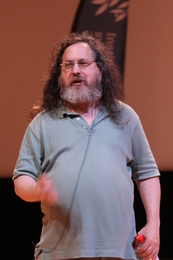
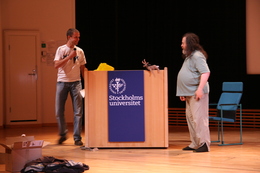
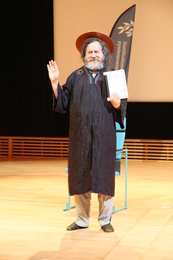
RMS in Sthlm

Claes and I started the foss-sthlm initiative a while ago, back in 2009. I’m sure I’ve mentioned that before. We’ve since then done a series of events where we’ve gathered foss hackers from the Stockholm region to speak about Free Software and Open Source for people interested in these issues. We’ve had 100+ persons attend to every event and I’ve considered them successful beyond our wildest expectations. Me and Claes originally expected to gather around 30 persons or so…

Interested?

So out of the blue I got a question from Giuseppe (who were talking to RMS at the time) if foss-sthlm/me would be interested in organizing an event in Stockholm with mr Stallman. It turned out mr Stallman was already considering coming to FSCONS in Gothenburg and when doing so he was looking around to see if he could do some more talks while in Sweden. Given this chance, I simply couldn’t turn it down!

We coordinated with our pals behind FSCONS (the lovely crew at FFKP) so that we would jointly fund the event. We would split the bill for getting mr Stallman here and onward again to his subsequent gig, and the cost for his travel between Stockholm and Gothenburg.

How many?

Ironically, we already before had talked about not getting one of these super celebs to foss-sthlm events simply because of their immense popularity and the problem to get facilities to host events with them. How many would come to an RMS talk? I guessed at least 300 since among our previous events the most popular one got around 150 visitors.

How to get a place?

Commercial rooms for at least 300 people are expensive and luckily we quite soon got in touch with friends at KTH in Sweden – The Royal Institute of Technology, and they graciously offered to sponsor a room for 500. Awesome, we were on our way!

Sponsors?

South Pole didn’t hesitate when I asked them (you rock, Jakob!), but immediately said they’d help us to sponsor the event. With them on board, we had all the financial stuff we needed covered and we could say “full steam ahead!” to everyone involved .

Fiddle like crazy

FSCONS had a fixed date for their conference already, but when would RMS come to Stockholm? After FSCONS or before? When would we be able to reserve the room and how would it all fit into RMS’s schedule of other things. Several times we thought we had nailed it when something changed and we had to redo it all again. It took a good amount of emails back and forth until we finally scheduled and decided that he’d be in Stockholm first and then go FSCONS.

Open for registrations!

We went public about RMS coming to Sweden coordinated with FSCONS so that none of us would take advantage of this on the others’ expense. On September 27th 13:22 we told everyone about it, and within less than eleven (11) hours all 500 seats in the room had been reserved!

Oops, full already

Wow. That was a bit overwhelming and not quite what I had expected. A bit tough, but well our room only fits 500 so…

Find a new place

Friendly people on the foss-sthlm list very soon mentioned a new, much larger, facility that perhaps could be possible to host Stallman’s talk. The huge Aula Magna room. I was a bit pessimistic about it, as I was just so happy already with having gotten a fine sponsorship for that first room.

New place, new sponsor

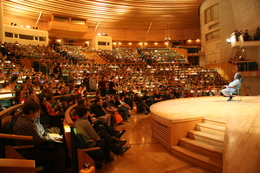
What are friends for? I can hardly describe it, but we have good friends in good places and wow, not many days passed until I got the excellent news that the Stockholm University‘s department for Computer and System’s Sciences would help us get the room and pay the bill for it. This massive room fits 1194 sitting visitors. (Thanks Beatrice, you’re awesome!)

More tickets

Amazingly enough, it was just a matter of time until we ran out of tickets again. Sure, this time there were tickets available for a longer time but well over a week before the RMS talk there were again no tickets available. The demand was still clearly very high. When the event was just a few days away, we sent out reminder emails and we got lots of ticket cancellations, perhaps 60-70 of them, and the tickets that were returned were immediately made available again on the ticket site and were soon signed up for again by other lucky souls.

When we closed the registration, there were just a few tickets still available. 1180 or so had been registered to listen to Richard M Stallman talk in Stockholm, a dull and grey November day 2011.

The speech

Richard is a charismatic person. He can speak to a huge audience for almost two hours, with no slides and no images and no script and still keep us all alert and interested. He mixes in dry humor and reflects back and recites episodes from previous speeches from time to time.

The topic was of course Free Software. About doing the right thing. About freedom and how you need to be prepared to sacrifice some things in order to gain and fight for freedom. For mr Stallman things are often black/white. It is either free and therefore right and fine, or it isn’t free and therefore morally wrong and a bad idea. He also spent quite a lot of time explaining why calling it GNU/Linux is the right thing and how mr Torvalds doesn’t care about the ethics and about doing the right thing for humanity.

I’ve been involved in Free Software (and in Open Source too, a term that RMS despises and encourages us all not to use) for many years but this was actually the first time I heard RMS talk live.

Thanks

This would not have been such a smooth ride with the efforts of Giuseppe, Claes and the eager help and assistance from all friends in #foss-sthlm. Thank you!

(The pictures in this blog entry are all CC-BY-SA licensed and are taken by Kjell Ericson)

Three out of one hundred

If I’m not part of the solution, I’m part of the problem and I don’t want to be part of the problem. More specifically, I’m talking about female presence in tech and in particular in open source projects.

3 out of 100I’ve been an open source and free software hacker, contributor and maintainer for almost 20 years. I’m the perfect stereo-type too: a white, hetero, 40+ years old male living in a suburb of a west European city. (I just lack a beard.) I’ve done more than 20,000 commits in public open source code repositories. In the projects I maintain, and have a leading role in, and for the sake of this argument I’ll limit the discussion to curl, libssh2, and c-ares, we’re certainly no better than the ordinary average male-dominated open source projects. We’re basically only men (boys?) talking to other men and virtually all the documentation, design and coding is done by male contributors (to a significant degree).

Sure, we have female contributors in all these projects, but for example in the curl case we have over 850 named contributors and while I’m certainly not sure who is a woman and who is not when I get contributions, there’s only like 10 names in the list that are typically western female names. Let’s say there are 20. or 30. Out of a total of 850 the proportions are devastating no matter what. It might be up to 3%. Three. THREE. I know women are under-represented in technology in general and in open source in particular, but I think 3% is even lower than the already low bad average open source number. (Although, some reports claim the number of female developers in foss is as low as just above 1%, geekfeminism says 1-5%).

Numbers

Three percent. (In a project that’s been alive and kicking for thirteen years…) At this level after this long time, there’s already a bad precedent and it of course doesn’t make it easier to change now. It is also three percent of the contributors when we consider all contributors alike. If we’d count the number of female persons in leading roles in these projects, the amount would be even less.

It could be worth noting that we don’t really have any recent reliable stats for “real world” female share either. Most sources that I find on the Internet and people have quoted in talks tend to repeat old numbers that were extracted using debatable means and questions. The comparisons I’ve seen repeated many times on female participation in FOSS vs commercial software, are very often based on stats that are really not comparable. If someone has reliable and somewhat fresh data, please point them out for me!

“Ghosh, R. A.; Glott, R.; Krieger, B.;
Robles, G. 2002. Free/Libre and Open Source Software: Survey and Study. Part
IV: Survey of Developers. Maastricht: International Institute of Infonomics
/Merit.

A design problem of “the system”

I would blame “the system”. I’m working in embedded systems professionally as a consultant and contract developer. I’ve worked as a professional developer for some 20 years. In my niche, there’s not even 10% female developers. A while ago I went through my past assignments in order to find the last female developer that I’ve worked with, in a project, physically located in the same office. The last time I met a fellow developer at work who was female was early 2007. I’ve worked in 17 (seventeen!) projects since then, without even once having had a single female developer colleague. I usually work in smaller projects with like 5-10 people. So one female in 18 projects makes it something like one out of 130 or so. I’m not saying this is a number that is anything to draw any conclusions from since it just me and my guesstimates. It does however hint that the problem is far beyond “just” FOSS. It is a tech problem. Engineering? Software? Embedded software? Software development? I don’t know, but I know it is present both in my professional life as well as in my volunteer open source work.

Geekfeminism says the share is 10-30% in the “tech industry”. My experience says the share gets smaller and smaller the closer to “the metal” and low level programming you get – but I don’t have any explanation for it.

Fixing the problems

What are we (I) doing wrong? Am I at fault? Is the the way I talk or the way we run these projects in some subtle – or obvious – ways not friendly enough or downright hostile to women? What can or should we change in these projects to make us less hostile? The sad reality is that I don’t think we have any such fatal flaws in our projects that create the obstacles. I don’t think many females ever show up near enough the projects to even get mistreated in the first place.

I have a son and I have a daughter – they’re both still young and unaware of this kind of differences and problems. I hope I will be able to motivate and push and raise them equally. I don’t want to live in a world where my daughter will have a hard time to get into tech just because she’s a girl.

Haxx, the second year

Last year I posted my report of what I and my fellows did at Haxx after the first year of true and real independence. As I probably mentioned before, we registered our company 1997 but it was just a side project for over a decade.Haxx logo

Now, when we’re slowly approaching two years it is time to look back and what we’ve done during the past twelve months and what we’re doing right now.

We have firmly established ourselves even more as expert developers within embedded systems. We’re over and over again being hired by the teams that themselves are hired by companies to provide services or products. During the last twelve months, we’ve written software and software designs for a huge medical equipment company, a small video equipment manufacturer, a major international telecom, a market-leading embedded systems provider and a global chip manufacturer. We’ve debugged simulation software, designed video streaming servers, done video subtitling magic, poked on Linux kernel code and we’ve done old-school 8051 and 16bit x86 assembly. I’ve also managed to do a Embedded Linux development (in user-space) training course – twice. All this, in just the past year!

Haxx was (and presented) at FSCONS in Gothenburg, we went to (and presented at) FOSDEM in Brussels and we went to the Rockbox devcon in London. We did lots of work within the foss-sthlm community.

Oh, and we’ve revamped our logo and graphical design.

Haxx consists of three full-time employed senior expert embedded systems consultants. We’ve all been in the industry for over twenty years: Daniel Stenberg, Björn Stenberg and Linus Nielsen Feltzing.

We continuously work with partners in the area to reach out to new and existing customers. As we’re very small and rather spend our time on working in our actual assignments we appreciate the help with sales and marketing. If you’re in the Stockholm area and ever end up needing devoted and skilled embedded software hackers, call us!

I’m gonna do my very best to make sure we get another great year! I’ll report back and tell you how it went.

foss-sthlm, the sixth, the controversial one

I’m happy to say that I was the main planner and organizer of yet another foss-sthlm meetup, the sixth. Last week we attracted about one hundred eager FOSS hackers to attend to this meeting to which I had found and cooperated a somewhat controversial sponsor.

We have had a discussion within foss-sthlm now due to this event’s sponsor: what kinds of companies are acceptable as sponsor for FOSS events and what are not? It is obvious that we have a lot of different opinions here and several people have expressed that they deliberately didn’t go to meetup #6 simply because of the sponsor’s involvement and relationship to the Swedish defence industry. Do you think a defence manufacturer or weapon systems creator can also have its good sides and sponsor good activities or should we distance ourselves from them?

I’m honestly still interested in more opinions on this. We have not formed a policy around this subject because I simply don’t think that’s a good idea. We’re not a formal organization and we all have our different views. I think we have our members hand around and participate as long as we stay within a reasonable “boundary”. If we would get involved with the wrong kind of companies, a larger portion of the group would boycott the meeting or just plainly leave foss-sthlm. But why would we ever? I’m the one who’s mostly been in touch with sponsors and I would certainly not get involved and ask for money from companies that I believe have crossed the magic line in the sand.

The meeting was perhaps the most techy and most advanced of them all so far, and I found the talks very inspiring and educating. I’ve not had time or energy to put up a page with pictures or descriptions of them, and I think I’ll just skip it. You should probably try harder to attend next time instead!

First time for Steering Board

Some years ago in the Rockbox project (2008 to be exact), we started the Rockbox Steering Board (RSB). A board with the intention of having a core group that would take final hard decision when consensus was not reached among developers, or when conflicts arise or whatever.

I was voted in as member of the board in the first RSB and I’ve been a member of it since. We have annual elections where we vote for 5 trusted persons to attend the board that potentially will make decisions for the project’s good.

But no real crises turned up. No discussion was so heated it wasn’t handled by the developers on the mailing list or over IRC. No decision was needed by the RSB. And time passed.

In February 2011, the first ever case for RSB was brought to us by a member of the project who felt there was potentially some wrong-doing going on or something that was done was against our established procedure.

The issue itself was not that easy to deal with, and it also quickly showed that all five of us RSB members are busy persons with lots of stuff going on in our own ends so each round of discussions and decision-makings took a really long time. In the end we really had to push ourselves to get a statement together and published before the pending release.

I think we did good in the end and I think we learned a little on how to do it better next time. But let’s hope it’ll take another few years until the RSB is brought out again… Thanks Jens, Marianne, Frank and Björn for a job well done!

Rockbox

Foss-sthlm number five!

In the series of Free Software and Open Source talks and seminars we’ve been doing in the Foss-sthlm community, we are about to set off the fifth meetup on February 24, 2011 in Kista, Stockholm, Sweden. This time we will offer six talks by six different persons, all skilled and well educated within their respective topics.

The event will be held completely in Swedish, and the talks that are planned to get presented are as following:

  1. Foss in developing nations – Pernilla Näsfors
  2. Open Source Framework Agreements in the Swedish Government – Daniel Melin
  3. From telecommunications to computer networks security for real-timecommunications over IP – Olle E Johansson
  4. Maintaining – how to manage your FOSS project – Daniel Stenberg (yes, that’s me)
  5. Peek in HTTP and HTTP traffic – Henrik Nordström
  6. Cease and desist, stories from threat mails received in the Rockbox project – Björn Stenberg

As usual, we do this admission free and our sponsor (CAG this time) will provide with something to eat and drink. After all the scheduled talks (around 20:00) we’ll continue the evening at a pub somewhere and discuss open source and free software over a beer or two.

See you there!

FSCONS 2010 day 2

[continued from FSCONS 2010 day 1]

With the previous night’s social event ending fairly late and involving a fair amount of good beers, it was nice to be able to sleep in a bit and have one of those great hotel breakfasts in a slow and relaxed manner.

I then checked out from the hotel and walked over to the venue, this time not as mislead by google maps’ directions as I was yesterday.

The economics of open innovation and FOSS. was the first session I attended and the talker Karthik Jayaraman did a good job of explaining and showing how things can happen fast and why and he did some interesting predictions of the future.

I followed Kathik’s talk in the same room with my 30 minute session Future transports in which I discussed and explained a bit about transport protocols today and what might come tomorrow.

Glyn Moody is a bit of a celebrity (he has for example written several books) and you can tell he’s done this before. He’s an excellent speaker and as he’s a native English person he has a bit of an edge compared to most speakers at this conference. Mr Moody got the biggest room at FSCONS filled up to the last available chair and there were still a bunch who had to sit on the floor.

Glyn talked about Ethical Monopolies, the history of patents and copyright and how they have changed and how they today no longer are even close to having the purposes they were created for.

He advocates that we stop talking about “Intellectual Properties” but instead refer to them as “Intellectual government-granted monopolies” as that is a much better use of words when these subjects are brought up. The ordinary person thinks people should be able to keep properties, but would in many cases object to (more) monopolies.

The last session I got to enjoy this year was Mikael von Knorring’s “Who are the free users” which did present a good view of things but I wasn’t very focused during the talk so I’ll refrain from judging it in any direction.

I took a last stroll over to the cafeteria area where I found some friends, said hello and good bye and then I took off towards the train station and my 3+ hours train ride back to Stockholm on the other coast of Sweden. (It could be noted that I left early, there were at least two session slots that I missed.)

My head is packed with impressions. I met lots of great people and friends, both old and many new ones. We had awesome discussions and I hope at least some of the ideas that were brought up will be turned into reality. I will post more about those here if/when they happen.

The future for Free Software (in the Nordic region) is bright!

FSCONS 2010 day 1

07:02: The alarm of my mobile never rang, because I was already up. I got to play with my two kids a while before the taxi arrived to pick me up at 07:30.

The X2000 train from Stockholm to Göteborg took off exactly on schedule and we were off. I learned that the on-board Internet service wasn’t possible to sign on to with Chrome but I had to fire up my good old Firefox for it. Going with first class X2000 offer free Internet all the way, and free coffee. Two of my favorite frees.

The train arrived only 10 minutes late in Gothenburg. I took a taxi over to my hotel, checked in, put my smaller laptop in my backpack and walked over to the FSCONS venue.

After having had lunch and caught up with some friends, I sat down in the big audience listening to the presentation about the Inhana project, by Kyrah. Interactive storytelling and about helping female artists in Syria to play/work with technology in the form av Arduino boards.

Kyrah had the room full. Not that many remained when I entered the stage after her and did my talk on scalable application layer transfers.

I followed up with a cup of coffee after some private discussions on SCTP and how to do fast transfers in the Tor project and then I headed towards the talk about data structures in the Linux kernel by Allesandro Rubini.

Mr Rubini is a long-time involved Linux kernel hacker (and well known co-author of the Linux Device Drivers bible) and in a very casual and effective style he taught us how we can use regular Linux code for lists and trees in a GPL licensed project and how the clever container_of macro works. To me, its biggest drawback is that it relies on a gcc-specific feature: typeof(), but otherwise it is a beautiful craftsmanship.

Allesandro brought down the biggest spontaneous applause when he responded to someone’s question “but couldn’t you also do this using templates in C++?” by suitably and appropriately bashing C++…

.Allesandro Rubini

Anders Arnholm followed along in the embedded track and he talked about using Linux in the automotive world and I think many of us thought the best part of his talk was the numbers and comparisons he had when trying different flash file systems to increase boot performance and really cut down startup time to a minimum. The initial kernel startup time was 6 something seconds when using JFFS2 and they managed to get down to below 200 milliseconds with the use of the AXFS (Advanced XIP Filesystem, where XIP is short for execute in place).

Anders Arnholm

boot-times-axfs

… after Anders’ talk I followed the crowds, got a seat in a bus and we were transported over to the social event. I mentioned a little bit about that in my previous post, the award for me.

My FSCONS 2010 day 2 entry will be posted within shortly.

The award for me

I was asked what the Nordic Free Software Award that I received last year meant to me. This was my response that I now repost here for the public to see:

Daniel WinnerTo me, the NFSA is a recognition from my own kind. A really big thumbs-up from within my own team. From fellow hackers who know.

In a world where we spend lots and lots of time alone in front of screens during long dark hours, where most of what you do is just silently pushed into source code repositories or consumed by eager downloaders distributed all over the world, getting that kind of positivism is invaluable.

I found it to not only be a very big ego boost, but it also really ignited my desire to do more, to reach further and to prove that my receiving of the award is the beginning and not the end of what I am set to do in our free software world. In my particular case it was a primary factor behind the start of the Foss-sthlm network that I co-started not long after I got the award. I’ve pushed foss-sthlm forwards during this year with several meetings with a hundred or more attendees.

Getting weird looks from outsiders or a thank you from the occasional user is fun, but getting an award from people who actually know what you might have done and what it takes to do it, is priceless.

I’m perfectly aware that I am the super-nerd. I’m not the social guy. I’m not the person who unite crowds or inspire teams to create miracles. I’m a software developer and I design and create code. Lots of it. I debate technical details, protocols and choices on mailing lists. Lots of them. I share as much as possible of all that of course and I’m thrilled that what I do is considered this good and is appreciated to this extent.

Everyone doing volunteer work wants to get recognition for their efforts. I got it. Thank you!

During the social event at FSCONS 2010 when we announced the winner of this year and handed him his prizes, I was also given the prize I never received last year because I wasn’t around at the actual award ceremony then. And of course, these guys love puns so…

Award prizes

From the left: a box with rocks (for my work on Rockbox), a transformer toy (I don’t quite recall the reason for that) and curlers (for my work on curl). Click on the image to see it in full resolution, it is taken with my crappy mobile camera.