
Tag Archives: HTTP/3

QUIC and missing APIs

I trust you’ve heard by now that HTTP/3 is coming. It is the next destined HTTP version, targeted to get published as an RFC in July 2019. Not very far off.

HTTP/3 will not be done over TCP. It will only be performed over QUIC, which is a transport protocol replacement for TCP that always is done encrypted. There’s no clear-text version of QUIC.

TLS 1.3

The encryption in QUIC is based on TLS 1.3 technologies which I believe everyone thinks is a good idea and generally the correct decision. We need to successively raise the bar as we move forward with protocols.

However, QUIC is not only a transport protocol that does encryption by itself while TLS is typically (and designed as) a protocol that is done on top of TCP, it was also designed by a team of engineers who came up with a design that requires APIs from the TLS layer that the traditional TLS over TCP use case doesn’t need!

New TLS APIs

A QUIC implementation needs to extract traffic secrets from the TLS connection and it needs to be able to read/write TLS messages directly – not using the TLS record layer. TLS records are what’s used when we send TLS over TCP. (This was discussed and decided back around the time for the QUIC interim in Kista.)

These operations need APIs that still are missing in for example the very popular OpenSSL library, but also in other commonly used ones like GnuTLS and libressl. And of course schannel and Secure Transport.

Libraries known to already have done the job and expose the necessary mechanisms include BoringSSL, NSS, quicly, PicoTLS and Minq. All of those are incidentally TLS libraries with a more limited number of application users and less mainstream. They’re also more or less developed by people who are also actively engaged in the QUIC protocol development.

The QUIC libraries in progress now are typically using either one of the TLS libraries that already are adapted or do what ngtcp2 does: it hosts a custom-patched version of OpenSSL that brings the needed functionality.

Matt Caswell of the OpenSSL development team acknowledged this situation already back in September 2017, but so far we haven’t seen this result in updated code shipped in a released version.

curl and QUIC

curl is TLS library agnostic and can get built with around 12 different TLS libraries – one or many actually, as you can build it to allow users to select TLS backend in run-time!

OpenSSL is without competition the most popular choice to build curl with outside of the proprietary operating systems like macOS and Windows 10. But even the vendor-build and provided mac and Windows versions are also built with libraries that lack APIs for this.

With our current keen interest in QUIC and HTTP/3 support for curl, we’re about to run into an interesting TLS situation. How exactly is someone going to build curl to simultaneously support both traditional TLS based protocols as well as QUIC going forward?

I don’t have a good answer to this yet. Right now (assuming we would have the code ready in our end, which we don’t), we can’t ship QUIC or HTTP/3 support enabled for curl built to use the most popular TLS libraries! Hopefully by the time we get our code in order, the situation has improved somewhat.

This will slow down QUIC deployment

I’m personally convinced that this little API problem will be friction enough when going forward that it will slow down and hinder QUIC deployment at least initially.

When the HTTP/2 spec shipped in May 2015, it introduced a dependency on the fairly new TLS extension called ALPN that for a long time caused head aches for server admins since ALPN wasn’t supported in the OpenSSL versions that was typically installed and used at the time, but you had to upgrade OpenSSL to version 1.0.2 to get that supported.

At that time, almost four years ago, OpenSSL 1.0.2 was already released and the problem was big enough to just upgrade to that. This time, the API we’re discussing here is not even in a beta version of OpenSSL and thus hasn’t been released in any version yet. That’s far worse than the HTTP/2 situation we had and that took a few years to ride out.

Will we get these APIs into an OpenSSL release to test before the QUIC specification is done? If the schedule sticks, there’s about six months left…


My talks at FOSDEM 2019

I’ll be celebrating my 10th FOSDEM when I travel down to Brussels again in early February 2019. That’s ten years in a row. It’ll also be the 6th year I present something there, as I’ve done these seven talks in the past:

My past FOSDEM appearances

2010. I talked Rockbox in the embedded room.

2011. libcurl, seven SSL libs and one SSH lib in the security room.

2015. Internet all the things – using curl in your device. In the embedded room.

2015. HTTP/2 right now. In the Mozilla room.

2016. an HTTP/2 update. In the Mozilla room.

2017. curl. On the main track.

2017. So that was HTTP/2, what’s next? In the Mozilla room.

DNS over HTTPS – the good, the bad and the ugly

On the main track, in Janson at 15:00 on Saturday 2nd of February.

DNS over HTTPS (aka “DoH”, RFC 8484) introduces a new transport protocol to do secure and private DNS messaging. Why was it made, how does it work and how users are free (to resolve names).

The presentation will discuss reasons why DoH was deemed necessary and interesting to ship and deploy and how it compares to alternative technologies that offer similar properties. It will discuss how this protocol “liberates” users and offers stronger privacy (than the typical status quo).

How to enable and start using DoH today.

It will also discuss some downsides with DoH and what you should consider before you decide to use a random DoH server on the Internet.

HTTP/3

In the Mozilla room, at 11:30 on Saturday 2nd of February.

HTTP/3 is the next coming HTTP version.

This time TCP is replaced by the new transport protocol QUIC and things are different yet again! This is a presentation about HTTP/3 and QUIC with a following Q&A about everything HTTP. Join us at Goto 10.

HTTP/3 is the designated name for the coming next version of the protocol that is currently under development within the QUIC working group in the IETF.

HTTP/3 is designed to improve in areas where HTTP/2 still has some shortcomings, primarily by changing the transport layer. HTTP/3 is the first major protocol to step away from TCP and instead it uses QUIC. I’ll talk about HTTP/3 and QUIC. Why the new protocols are deemed necessary, how they work, how they change how things are sent over the network and what some of the coming deployment challenges will be.

DNS Privacy panel

In the DNS room, at 11:55 on Sunday 3rd of February.

This isn’t strictly a prepared talk or presentation but I’ll still be there and participate in the panel discussion on DNS privacy. I hope to get most of my finer points expressed in the DoH talk mentioned above, but I’m fully prepared to elaborate on some of them in this session.

HTTP/3 talk in Stockholm on January 22

HTTP/3 – the coming HTTP version

This time TCP is replaced by the new transport protocol QUIC and things are different yet again! This is a presentation by Daniel Stenberg about HTTP/3 and QUIC with a following Q&A about everything HTTP.

The presentation will be done in English. It will be recorded and possibly live-streamed. Organized by me, together with our friends at goto10. It is free of charge, but you need to register.

When

17:30 – 19:00
January 22, 2019

Goto 10: Hörsalen, Hammarby Kaj 10D plan 5

Register here!

Fancy map to goto 10


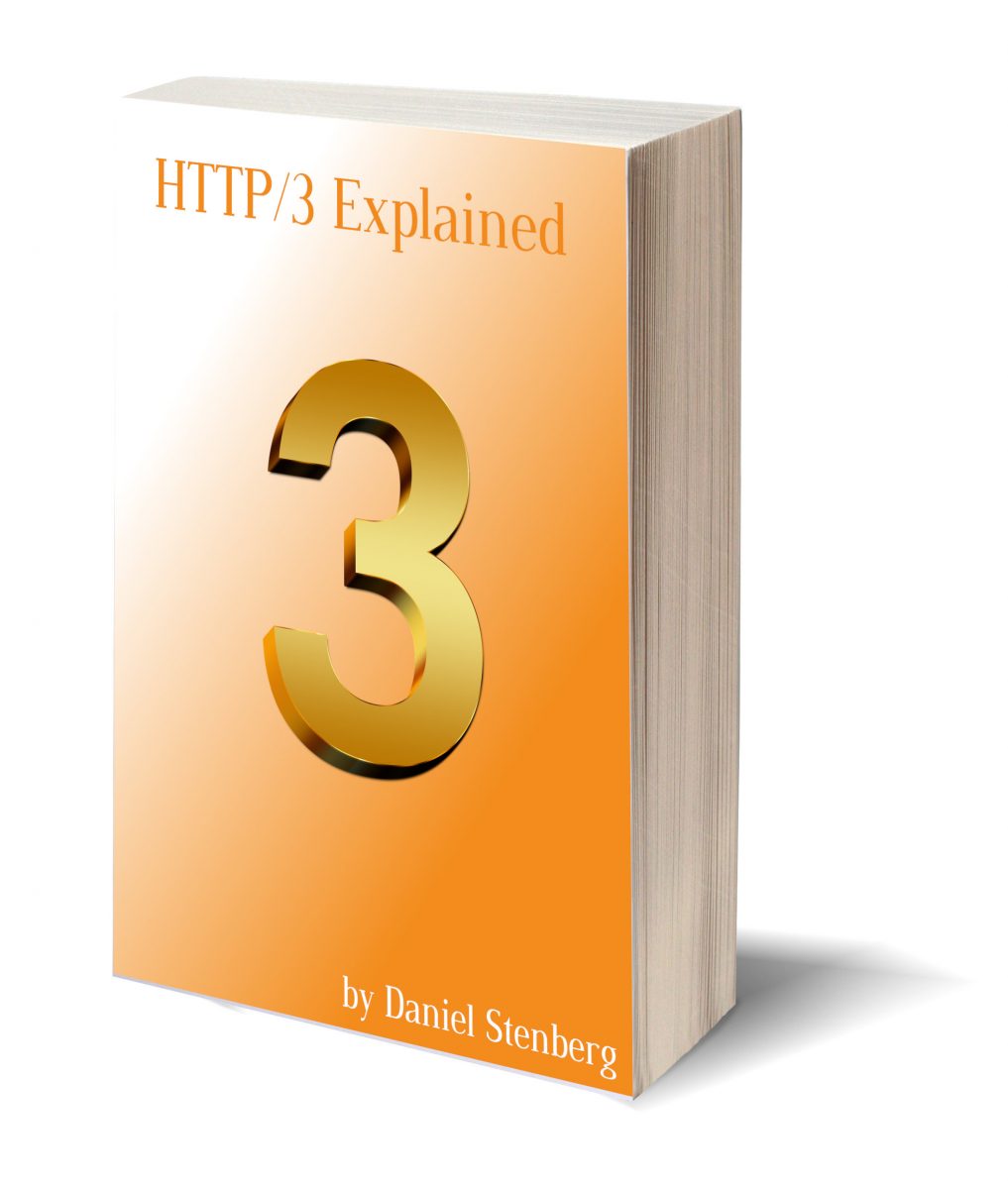
HTTP/3 Explained

I’m happy to tell that the booklet HTTP/3 Explained is now ready for the world. It is entirely free and open and is available in several different formats to fit your reading habits. (It is not available on dead trees.)

The book describes what HTTP/3 and its underlying transport protocol QUIC are, why they exist, what features they have and how they work. The book is meant to be readable and understandable for most people with a rudimentary level of network knowledge or better.

These protocols are not done yet, there aren’t even any implementation of these protocols in the main browsers yet! The book will be updated and extended along the way when things change, implementations mature and the protocols settle.

If you find bugs, mistakes, something that needs to be explained better/deeper or otherwise want to help out with the contents, file a bug!

It was just a short while ago I mentioned the decision to change the name of the protocol to HTTP/3. That triggered me to refresh my document in progress and there are now over 8,000 words there to help.

The entire HTTP/3 Explained contents are available on github.

If you haven’t caught up with HTTP/2 quite yet, don’t worry. We have you covered for that as well, with the http2 explained book.

HTTP/3

The protocol that’s been called HTTP-over-QUIC for quite some time has now changed name and will officially become HTTP/3. This was triggered by this original suggestion by Mark Nottingham.

The QUIC Working Group in the IETF works on creating the QUIC transport protocol. QUIC is a TCP replacement done over UDP. Originally, QUIC was started as an effort by Google and then more of a “HTTP/2-encrypted-over-UDP” protocol.

When the work took off in the IETF to standardize the protocol, it was split up in two layers: the transport and the HTTP parts. The idea being that this transport protocol can be used to transfer other data too and its not just done explicitly for HTTP or HTTP-like protocols. But the name was still QUIC.

People in the community has referred to these different versions of the protocol using informal names such as iQUIC and gQUIC to separate the QUIC protocols from IETF and Google (since they differed quite a lot in the details). The protocol that sends HTTP over “iQUIC” was called “hq” (HTTP-over-QUIC) for a long time.

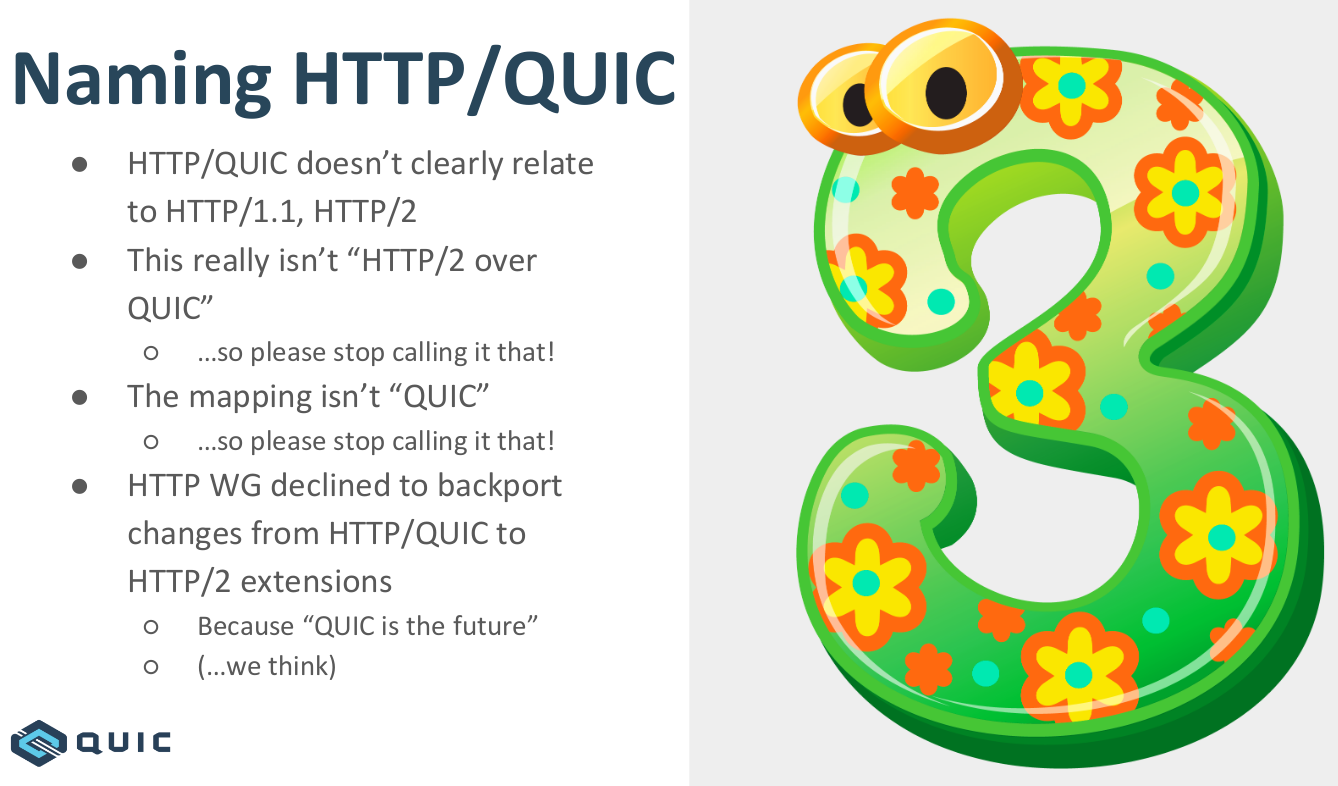
Mike Bishop scared the room at the QUIC working group meeting in IETF 103 when he presented this slide with what could be thought of almost a logo…

On November 7, 2018 Dmitri of Litespeed announced that they and Facebook had successfully done the first interop ever between two HTTP/3 implementations. Mike Bihop’s follow-up presentation in the HTTPbis session on the topic can be seen here. The consensus in the end of that meeting said the new name is HTTP/3!

No more confusion. HTTP/3 is the coming new HTTP version that uses QUIC for transport!

Workshop day two

HTTP Workshop At 5pm we rounded off another fully featured day at the HTTP workshop. Here’s some of what we touched on today:
Moritz started the morning with an interesting presentation about experiments with running the exact same site and contents on h1 vs h2 over different kinds of networks, with different packet loss scenarios and with different ICWND set and more. Very interesting stuff. If he makes his presentation available at some point I’ll add a link to it.

I then got the honor to present the state of the TCP Tuning draft (which I’ve admittedly been neglecting a bit lately), the slides are here. I made it brief but I still got some feedback and in general this is a draft that people seem to agree is a good idea – keep sending me your feedback and help me improve it. I just need to pull myself together now and move it forward. I tried to be quick to leave over to…

Jana, who was back again to tell us about QUIC and the state of things in that area. His presentation apparently was a subset of slides he presented last week in the Berlin IETF. One interesting take-away for me, was that they’ve noticed that the amount of connections for which they detect UDP rate limiting on, has decreased with 2/3 during the last year!

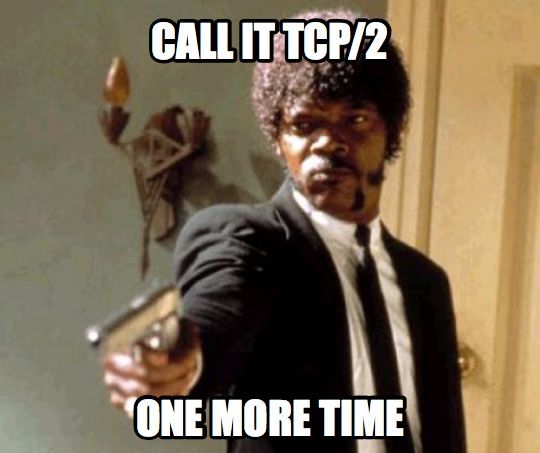
Here’s my favorite image from his slide set. Apparently TCP/2 is not a name for QUIC that everybody appreciates! 😉

call-it-tcp2-one-more-time

While I think the topic of QUIC piqued the interest of most people in the room and there were a lot of questions, thoughts and ideas around the topic we still managed to get the lunch break pretty much in time and we could run off and have another lovely buffet lunch. There’s certainly no risk for us loosing weight during this event…

After lunch we got ourselves a series of Lightning talks presented for us. Seven short talks on various subjects that people had signed up to do

One of the lightning talks that stuck with me was what I would call the idea about an extended Happy Eyeballs approach that I’d like to call Even Happier Eyeballs: make the client TCP connect to all IPs in a DNS response and race them against each other and use the one that responds with a SYN-ACK first. There was interest expressed in the room to get this concept tested out for real in at least one browser.

We then fell over into the area of HTTP/3 ideas and what the people in the room think we should be working on for that. It turned out that the list of stuff we created last year at the workshop was still actually a pretty good list and while we could massage that a bit, it is still mostly the same as before.

Anne presented fetch and how browsers use HTTP. Perhaps a bit surprising that soon brought us over into the subject of trailers, how to support that and voilá, in the end we possibly even agreed that we should perhaps consider handling them somehow in browsers and even for javascript APIs… ( nah, curl/libcurl doesn’t have any particular support for trailers, but will of course get that if we’ll actually see things out there start to use it for real)

I think we deserved a few beers after this day! The final workshop day is tomorrow.

HTTP/2 in April 2016

On April 12 I had the pleasure of doing another talk in the Google Tech Talk series arranged in the Google Stockholm offices. I had given it the title “HTTP/2 is upon us, and here’s what you need to know about it.” in the invitation.

The room seated 70 persons but we had the amazing amount of over 300 people in the waiting line who unfortunately didn’t manage to get a seat. To those, and to anyone else who cares, here’s the video recording of the event.

If you’ve seen me talk about HTTP/2 before, you might notice that I’ve refreshed the material somewhat since before.

Summers are for HTTP

stockholm castle and ship
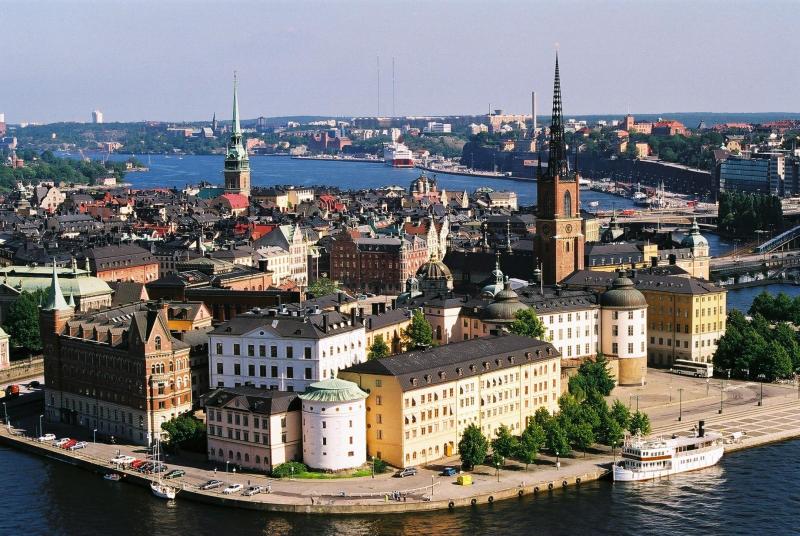
Stockholm City, as photographed by Michael Caven

In July 2015, 40-something HTTP implementers and experts of the world gathered in the city of Münster, Germany, to discuss nitty gritty details about the HTTP protocol during four intense days. Representatives for major browsers, other well used HTTP tools and the most popular HTTP servers were present. We discussed topics like how HTTP/2 had done so far, what we thought we should fix going forward and even some early blue sky talk about what people could potentially see being subjects to address in a future HTTP/3 protocol.

You can relive the 2015 version somewhat from my daily blog entries from then that include a bunch of details of what we discussed: day one, two, three and four.

http workshopThe HTTP Workshop was much appreciated by the attendees and it is now about to be repeated. In the summer of 2016, the HTTP Workshop is again taking place in Europe, but this time as a three-day event slightly further up north: in the capital of Sweden and my home town: Stockholm. During 25-27 July 2016, we intend to again dig in deep.

If you feel this is something for you, then please head over to the workshop site and submit your proposal and show your willingness to attend. This year, I’m also joining the Program Committee and I’ve signed up for arranging some of the local stuff required for this to work out logistically.

The HTTP Workshop 2015 was one of my favorite events of last year. I’m now eagerly looking forward to this year’s version. It’ll be great to meet you here!

Stockholm
The city of Stockholm in summer sunshine