Tag Archives: QUIC

Workshop Basel day two

If you missed it. I already described day one.

Caffeinated and ready, we all gathered in the same spacious room as yesterday, but seated in new places as “suggested” by our captain. Some of us even remembered to move over the name tags we wrote yesterday to our new seats.

No time was wasted on introductions today. We dove straight in at the deep end.

How AI is changing how HTTP is implemented.

Is the future of software that we check-in the AI prompts in the git repository and trust it to generate the correct code? Are specifications the new level o

f abstraction for source code? These questions triggered long discussions with a huge mix of opinions and experiences getting shared about how AI is used, should be used and could be used now and in the future. 

Observations and Measurements of HTTP/2 During Large-Scale Web Crawls

The Common Crawl spidering upgraded to using HTTP/2 for their scan and as an end result, I believe 61% of the responses used HTTP/2 and the entire round ended a few percent faster than before, which when you traverse a few billion URLs really makes a difference. They apparently use a locally patched version of Apache Nutch for this.

HTTP/1.1 behavior divergence

The HTTP probe project runs a lot of tests on HTTP/1 servers and compares how they behave in a lot of different aspects and then generates these awesome tables. Looks like something for every server implementer team to have a look at and decide what of these red boxes that should rather be converted into green alternatives.

Request smuggling test suite 

HTTP Zoll is a new test suite for intermediaries that tests intermediaries (what we often call proxies) for a large amount of request and response smuggling issues. Some real world problems found were discussed and as this project aims at going Open Source words were expressed on what kind of precautions and checks that maybe should be done first. I hope we get to hear more about this project soon.

Server performance & measurement

The HTTP Arena is another project that does performance and measurements. They test HTTP server frameworks and present the results in various ways on their site.

Increase and evolve HTTP/3 & QUIC

In this presentation, we were presented with different HTTP/3 deployment numbers from different sources and the associated reasoning around why they differ but then more importantly. what can and should be done to increase HTTP/3 usage. 

Anti-virus interceptions, enterprise blocks and server-side performance not yet on par with TCP were mentioned as reasons for holding back the numbers.

Reasons for using HTTP/3 include use cases that encourage QUIC adoption: WebTransport, Media over QUIC and MASQUE (HTTP/3 proxies and HTTP/3 proxies over older HTTP proxies). 

Using HTTPS-RR for upgrade was promoted, as every alt-svc response that is returned with an ALPN using h3 should perhaps also offer h3 over DNS. Why doesn’t your server announce its h3 support over HTTPS-RR?

QUIC v2 is deployed on an amazing 0.003% of all QUIC v1 domains and there was a discussion why this is so and the common sentiment in the room seemed to be that very few saw a reason for deploying v2 and several expressed a concern that doing so might in fact introduce issues. Someone (you can probably guess who) in the room increased that number a lot by quietly mentioning that haxproxy.org certainly supports it.

QMUX

QUIC multiplexing over bi-directional streams is a proposal on how to do QUIC-style multiplexing over TLS (or anything else really). It has been adopted by the IETF QUIC working group and there was a somewhat extended discussion about what the HTTPbis group should or should not do with it. The biggest interest might be for data center use, but is that then something IETF should bother about? This is not the first time I blog about this, and even if there did not seem to be a strong demand or need for this, it also did not seem to be completely dead. I bet we will hear more about this later.

Multiplexed proxying: challenges in H2 and H3

Doing a TLS terminating MITM proxy has its challenges and we were given some insights and experiences on the challenges of doing HTTP/2 and HTTP/3 to the server.

The browsers refuse to do HTTP/3 when they detect custom CA certs installed, which apparently is mostly because of lots of past bad experiences with anti-virus software that in particular seems to break QUIC and for users it is not obvious where the blame should go. This then makes browsers not do HTTP/3 over any MITM proxy.

Some time was spent on how allowing different clients to the proxy uses a shared h2 connection to the target server is complicated and not used, even though in theory it should be possible. An argument was made that it could even lead to worse performance than when using HTTP/1 but I could not quite follow that reasoning. I’m sure I missed some subtle detail in that explanation.

Making the Web QUICer with Rapid Start

When the afternoon is running late and we have been promised beer and snacks after the final talk, what is better than a hard core technical presentation with lots of graphs and numbers showing how QUIC performance can be improved by tweaking the congestion control algorithm and send more data in the startup phase of a new QUIC connections? This new approach is called Rapid Start and it looks like a promising and yet simple improvement. According to experiments done on real world traffic, the time to last byte was reduced by 14.7% on average. Not bad at all.

Drinks and food

Our meeting sponsor Adobe graciously sponsored drinks and food so we got to linger around for a few extra hours and talk even more HTTP and networking until the personal firmly insistent they needed us to leave the room and we instead continued solving world problems elsewhere. Topics around the table included the famous HTTP/2 spec coin flip, the QUIC spin bit, the SCONE situation for QUIC, the timeline behind the QUERY method and many more great stories.

Thanks for the beer!

Now we can’t wait for day three.
Workshop Basel day one

On this hot summer’s day in Basel, Switzerland, the seventh HTTP workshop started. These events tend to work roughly the same way and the people in the room are also to large extent familiar and known since previous editions. Forty people in a meeting room, where we take turns in doing short talks on HTTP and networking topics, with the following question and discussion session. The rules for the meetings are explicitly Chatham rules, which means that everything I write about the meeting will be sufficiently fuzzy and without many company or personal names. This is not the kind of meeting that can be easily summed up in a short blog post anyway. You really should be here.

Present in the room were representatives from all the world’s most prominent and used HTTP deployments: clients, browsers, CDNs, proxies and servers. I’m happy to say that there were also several first-timers. We like fresh blood.

(If you think I’m being overly brief or vague about specifics in this post; that is partially on purpose but primarily because I’m a lousy note-taker and mostly write this up after a busy day that also may have involved beer.)

After a round of introductions, we started.

Extending REST for State synchronization

REST is a set of constraints, and in this presentation it was argued that it can or maybe even should be extended to do more. A number of recent applications like Mastodon/ActivityPub, Bluesky/AT, Matrix, Nostr, IndieWeb, all currently use HTTP to do state synchronization but they all do it differently in their own unique ways. Can REST and maybe HTTP be adjusted to help this for improved interoperability?

Last-Modified header use over time

Looking at the Common Crawl data and comparing data over time, it was observed that responses use the Last-Modified header field more now than they did in the past, and there were great follow-up speculations on why this is so. Data also shows that a large share of these headers present dates that are almost identical to the time the requests were issued.

How is HTTP used in the world?

With the cc-lint tool, data was gathered on how HTTP is actually used today, proving that there is work to be done: deprecated headers are used, some headers are done wrong, and many are overly big. This indicates that there are well used both servers and clients out there that would benefit from cleanup. It probably also shows that doing HTTP correctly and all the correct headers is far from an easy task.

AI-bots’ use of HTTP

Another presentation showed data, this time from a well-known CDN, on the impact the existing AI scraper bots have on the Internet from their point of view. It showed that roughly half of the requests and half of the bandwidth are spent by scraper bots. A long discussion followed where the numbers were questioned as maybe the numbers look like this because a sufficiently large number of the “bad AI scrapers” appear as regular users to the classifiers. Speculations of different kinds were made. 

The Apple HTTP stack two years later

As a follow-up from a presentation from a previous HTTP workshop we got to learn how the journey on developing their new HTTP stack has progressed and several fun adventures and lessons from that were shared with the audience.

Why new HTTP APIs?

A look into new HTTP API development at Apple. Some discussions and lessons learned from creating new APIs for both servers and clients.

Android Networking

We got an excellent walk-through of some details and internals of the Android networking stack. Emphasis was perhaps especially put on ECH and QUIC connection migration, and the final “don’t tell us when your connection closed” led to a long new discussion on how we really should fix the problem: when connection has been left idle for a long time and it is closed by the server, the client (mobile phones) don’t want to be told. This, because getting that RST and more, just wakes up the radio and more on the phone only to tell it to go back to sleep. It was theorized that if we could get rid of this unnecessary battery waste, the accumulated gain across billions of devices would make a serious dent.

Day one world problem solving

Several additional HTTP related problems were of course also subsequently solved as we then wandered into the city for dinner and maybe a beer. Of course yours truly returned back to his hotel room in good time to be able to write up this blog post.

The best part of these workshops might be the (no pun intended) networking and discussions had completely outside of the agenda.

End of day one. Two more to come,

More HTTP/3 focus, one backend less

In the curl project we have a long tradition of offering multiple optional backends for specific protocols. In this spirit we have added experimental support for a number of different HTTP/3 + QUIC backends over time. A while ago we dropped one of those experiments, the msh3 backend.

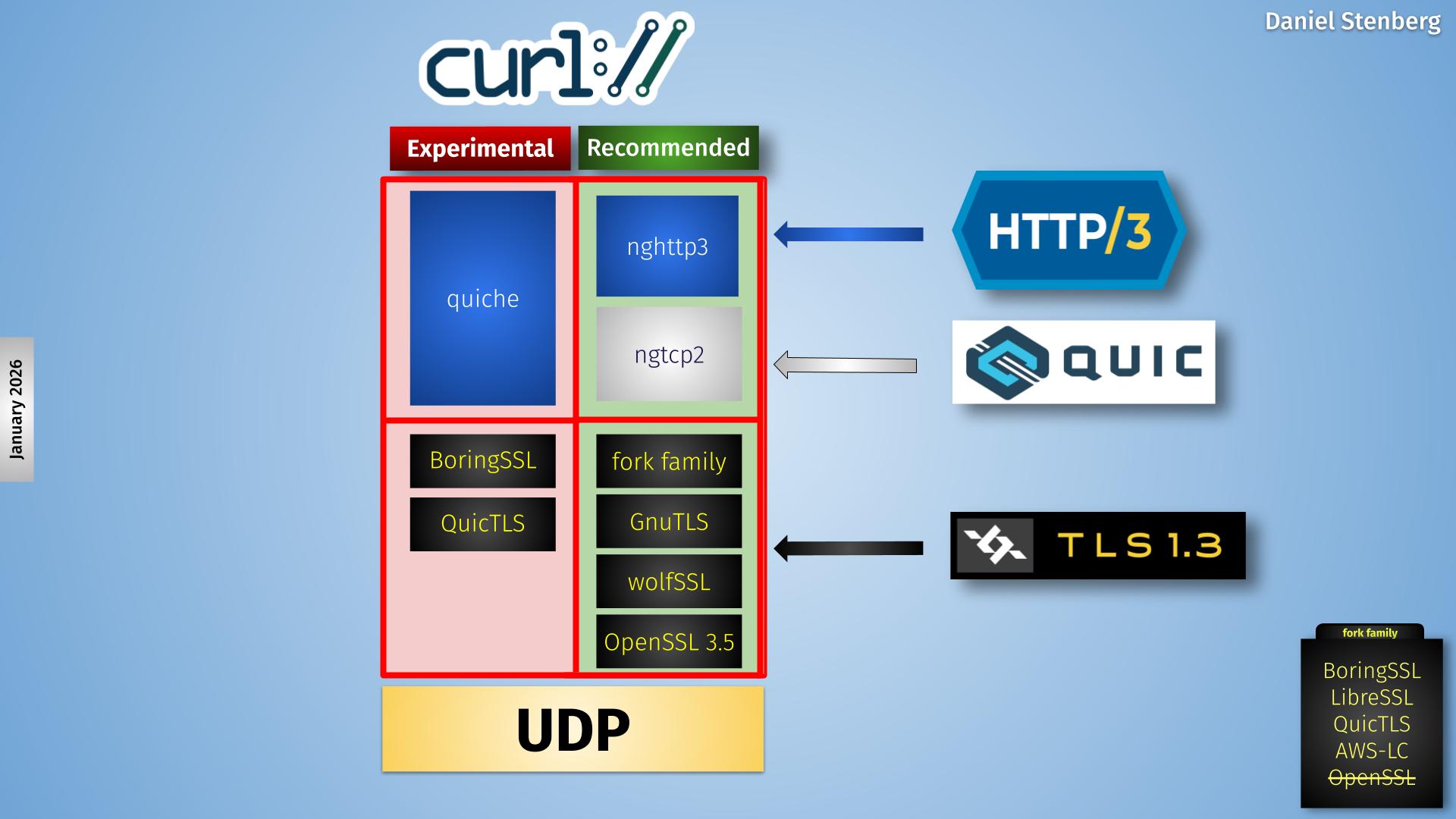
Today we cleanup even more and remove support for yet another backend: the OpenSSL-QUIC stack and we are now down to only supporting two different HTTP/3 alternatives: the ngtcp2 + nghttp3 combo or quiche. And out of those two, the quiche backend is still considered experimental.

The first release shipping with this change will be curl 8.19.0.

OpenSSL-QUIC

This is the QUIC stack implemented and provided by OpenSSL. To make matters a little complicated, this is a separate thing from the QUIC API that OpenSSL also offers. The first one is a full QUIC implementation, the second one is an API that is powerful enough to allow a separate QUIC implementation use OpenSSL for its cryptographic and TLS needs.

A quick recap how history unfolded

2019 – BoringSSL introduced an API for QUIC. QUIC implementations picked it up and it worked. A pull request was made for OpenSSL to allow them to provide the same API so that QUIC stacks all over could use OpenSSL.

2021 – OpenSSL eventually denied merging the pull-request and announced they would instead implement their own QUIC stack – that nobody had asked for.

2023 – OpenSSL 3.2 shipped with support for their own QUIC stack. It was broken in many ways.

2025: OpenSSL version 3.4.1 was released and now the QUIC stack worked decently. In OpenSSL 3.5.0 they announced a QUIC API that now finally allowed independent QUIC stacks to use OpenSSL.

Experimental

Skilled contributors added support for OpenSSL-QUIC to curl primarily to allow people using OpenSSL to still be able to use HTTP/3.

OpenSSL’s own QUIC implementation only reached experimental state in curl meaning that we explicitly and strongly discourage users from using it in production and reserve ourselves the right to change functionality and more between versions.

There are three reasons why it did not graduate from experimental and they are also the reasons why we think we are better off without offering support for it:

  1. The API is lacking. We have communicated with the OpenSSL-QUIC team since even before the API first shipped and it still does not offer the knobs and controls we would like to make it a competitive QUIC alternative. We don’t feel they care much.
  2. The performance is bad. And by bad I mean really bad. The leading QUIC implementation alternative ngtcp2 transfers data much faster in all benchmarks and comparisons. Sometimes up to a factor three difference.
  3. The memory use is abysmal. The amount of more memory required to do transfers with OpenSSL-QUIC compared to ngtcp2 can reach a factor twenty.

A drawing

This makes the curl backend situation simpler in the HTTP/3 and QUIC department as the image below tries to show.

Carving out msh3

I hope that by now most readers of my blog have understood that curl, and libcurl specifically, is an architecture with a transfer core with a set of different backends plugged in. Backends powered by different third party libraries.

The exact set of backends used in a particular build is decided by the person that builds curl.

What backends that curl supports varies over time (and platform). We appreciate adding support for more backends and to let users decide which ones to use, as this allows us to approach it with a survival of the fittest attitude. What does not work in the long run or what isn’t actually used, we can deprecate and remove again. Ideally this helps us select the better ones for the future.

HTTP/3

For the last few years curl has supported the HTTP/3 protocol powered by one out of four different backends:

  1. nghttp3 + ngtcp2
  2. quiche
  3. nghttp3 + OpenSSL-QUIC
  4. msh3 + msquic

(All except the first listed combination, we still label experimental.)

Dropping msh3

In this quartet, there is one option that stands out a little: the last one. The msh3 powered backend was brought in and merged into the curl source tree a few years ago with the hope that this solution would end up a good choice for people on Windows since it is the only choice in the list that can get built to use the native Windows TLS solution SChannel.

Unfortunately, this work was never finalized. It never worked correctly in curl and the API and architecture of msh3 makes it quirky and cumbersome to integrate – and quite frankly we can’t seem to drum up any interest for people to test nor work on improving this backend.

As we have three other working backends, all of which also can build and run on Windows, we see no benefit in dragging msh3 along. In fact, there is a cost in maintenance and keeping the build working and the tests running etc that we rather avoid. In particular as we seem to be doing that for virtually no gain.

I want to stress that I don’t think there is anything wrong with msh3 nor its underlying msquic library. They simply have not been made to work properly in curl.

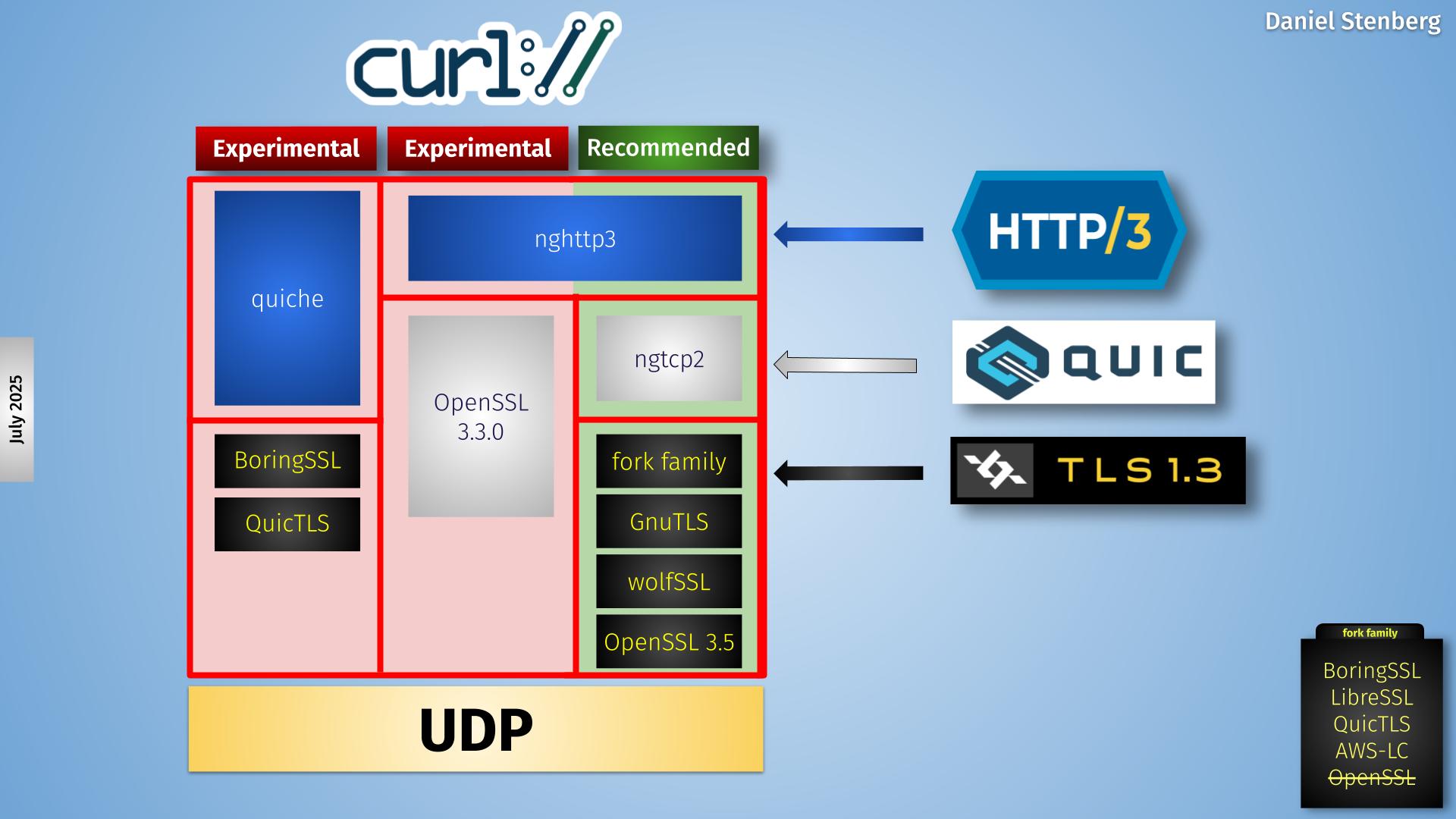
Updated backend map

The msh3 backend has now been removed from git in the current master branch and this is how the HTTP/3 offer will look like in the coming curl 8.16.0 release.

OpenSSL does a QUIC API

But will it satisfy the world?

I have blogged several times in the past about how OpenSSL decided to not ship the API for QUIC a long time ago, even though the entire HTTP world was hoping for it – or even expecting it. OpenSSL rejected the proposal to merge the proposed API and thereby implicitly decided to obstruct wide QUIC and HTTP/3 adoption outside browsers.

The OpenSSL team instead proclaimed that their ambition and goal was to implement their own QUIC stack and offer that to users. The OpenSSL team took a long time to implement it, but has shipped their own stack implementation and API since OpenSSL 3.2 – first released in November 2023.

Lagging behind

In the curl project we have been on top of this game all the way. We made curl capable of using OpenSSL-QUIC as a backend for QUIC (using nghttp3 for the HTTP/3 parts) as soon as that arrived. We immediately reported obvious flaws and omissions in their API and we have worked with the OpenSSL team over time as they have slowly but gradually addressed most (but not all) of our concerns.

Lots of other QUIC stack implementations have spent years in beta state, working out and polishing their implementations and APIs. OpenSSL went fairly quickly into shipping something they say can be used in production.

OpenSSL-QUIC considered experimental

We still consider the curl backend using the OpenSSL-QUIC implementation as experimental and discourage users from using such builds in production. Now primarily because it is a performance and resource hog compared to the competition.

The OpenSSL-QUIC implementation using curl has been measured up to 4 times (!) slower than ngtcp2 using up to 25 times (!) the amount of memory.

The API is different

The API OpenSSL finally merged on February 10, 2025 is however not the exact same API that was proposed many years ago, the API that BoringSSL, quictls and the others have been offering for many years by now. It is different, and because of this the QUIC implementations that want to use it need to adapt specifically for this and cannot just interchangeably switch between the many OpenSSL forks. It uses a pull concept versus the push of what other provides.

Additionally, the pull requests mentions: At the moment our QUIC stack does not support early data. A significant missing feature compared to what the OpenSSL forks (and other libraries) support.

When I asked the OpenSSL team about how they came to ship such a different API to what everyone else offers and what QUIC implementers have been asking for, the given explanation was:

– The API is layered on what we use internally to plug in our QUIC client and server implementations in a clean manner […] We did get some feedback from other QUIC stacks – but the proof will be in actual usage which we expect will occur most likely after the 3.5 release is out.

Rumors have it that they say they spoke to four QUIC stack authors and they all had planned to support it.

I don’t know which four stacks this was, and I’m curious to see this happen. Most QUIC stacks are not written to handle different TLS libraries with different APIs, so they would either add that support now or switch to a different API all together. Either way, not a trivial undertaking.

Also “planning to support it” is easy to say. Could also just mean at some point in a distant future.

ngtcp2 is the world’s generic QUIC stack

There are multiple QUIC implementations out there, but the only one that has had the idea of being TLS library independent already from its start, is ngtcp2.

Since curl supports ngtcp2 for QUIC, it can then also work with any of the TLS libraries ngtcp2 supports: BoringSSL, AWS-LC, quictls, wolfSSL, GnuTLS. This fits the curl mindset very well.

ngtcp2 is also the only QUIC stack curl supports right now that is not considered experimental.

Could in theory ease HTTP/3 adoption

Assuming the API works, and assuming ngtcp2 can make use of the API in a fine way, this unexpected change of attitude could be the move that suddenly and for real makes HTTP/3 adoption in and with curl take off. OpenSSL has a firm grip of the TLS library landscape (in particular in the Open Source realm) and a huge share of curl users uses it. Starting with the pending OpenSSL version 3.5 in the spring of 2025, building with curl + OpenSSL can then possibly enable HTTP/3.

So will it? I asked a lead developer of the ngtcp2 library if they are going to work on adding an adaptation for the new OpenSSL 3.5 API.

– I have no plan to do that. OpenSSL QUIC API lacks 0rtt support and its pulling crypto data is not ideal for me, other TLS stacks do not do that. Basically, the current state is inferior than what we have proposed 6 years ago. I will revisit this after OpenSSL adds 0rtt support and revise its pull model.

(Clearly they were not one of the four stack authors OpenSSL talked to.)

While this does of course not prevent someone else from doing the work, even thought the 0RTT limitation is something that primarily has to be added to the OpenSSL API, it might imply that it will not happen immediately.

In my opinion, I think it could be useful and educational if the OpenSSL project themselves wrote that adaptation for ngtcp2 to “dogfood” their own API.

curl

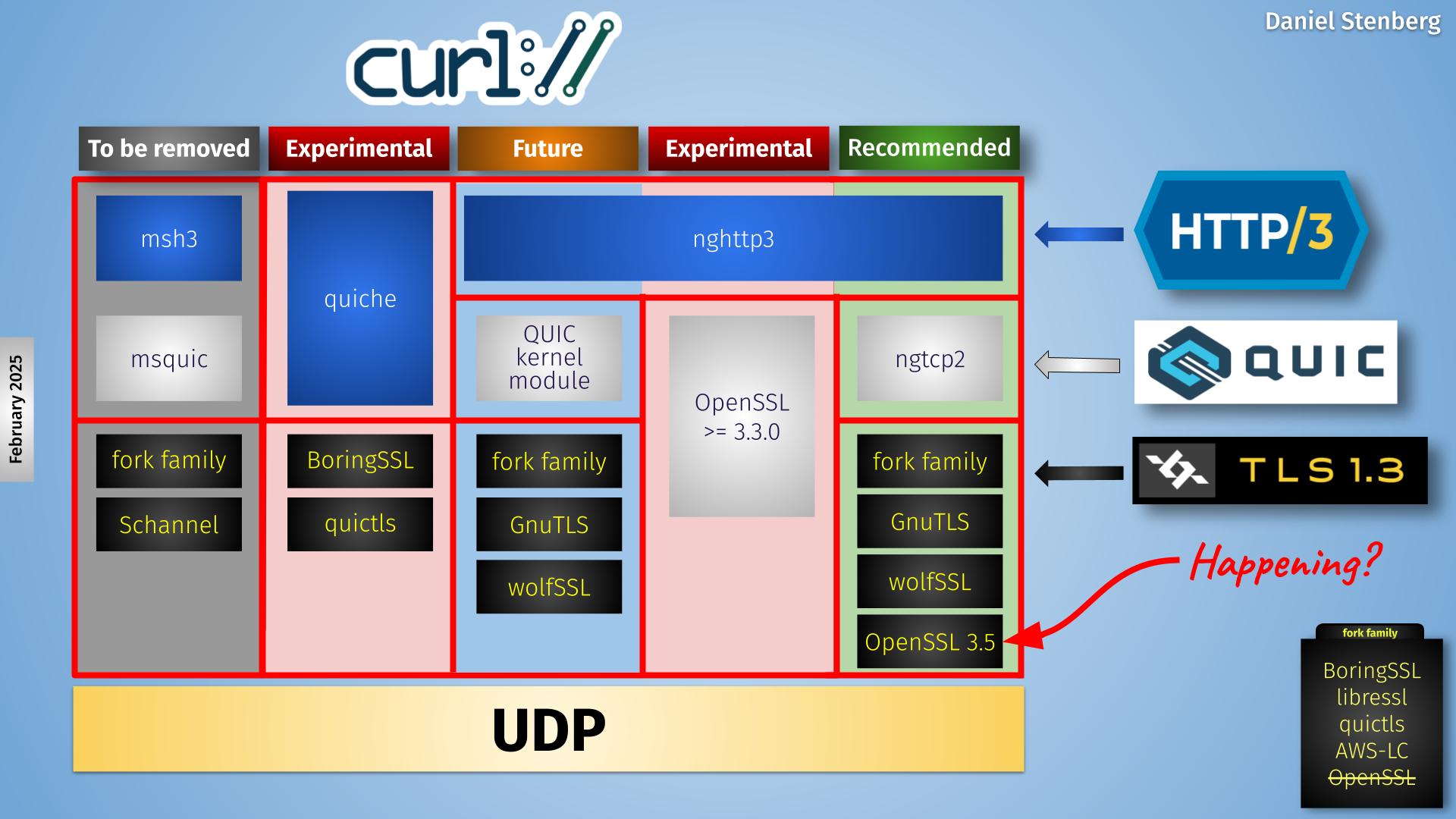
An attempt to illustrate the QUIC stack situation in current curl is shown below.

Currently curl supports four backends, out of which one (msh3) is scheduled for removal later this year and one (the kernel module version) is still only proposed for future inclusion – waiting for the kernel module to actually get adopted into the Linux kernel.

This leaves three actively developed backends, out of which one (ngtcp2) is the one we recommend and push for. The quiche and the OpenSSL-QUIC ones are still experimental.

The new OpenSSL API I discuss in this blog post is the one that would populate the lower right box, providing a TLS API for the QUIC library running on top of it. Hence me putting the red “happening?” text for this puzzle piece.

The red column second from the right is the OpenSSL-QUIC solution, using OpenSSL’s QUIC implementation.

Early days

It has not even been a week since this new API was merged into OpenSSL’s git repository, so it is far too early to give any predictions. Presumably it won’t even be used much for real by others until it gets shipped in a public release, planned to happen in April 2025.

Update

On February 26, there was another OpenSSL update: the QUIC API now offers 0-RTT support and they say this will be part of what ships in 3.5.

Selecting HTTP version (three)

The latest HTTP version is called HTTP/3 and is being transferred over QUIC instead of the old classic TCP+TLS duo.

An attempt of an architectural drawing could look like this:

HTTP network stacks

Remember: experimental

HTTP/3 support in curl is still experimental so we do reserve the right to change names, behavior and functionality during development.

We aim to remove this experimental label from HTTP/3 support during the spring of 2023.

HTTP/3 is for HTTPS only

Before we dig into the details of this, remember that HTTP/3 can and will only be used for HTTPS:// URLs. It is always encrypted and there is no way to do HTTP/3 over clear text. Asking to do HTTP/3 with a HTTP:// URL is therefor a non-starter. An error.

Cannot upgrade a connection

When HTTP/2 was introduced to the world, there was a companion TLS extension created called ALPN that allows a client to ask for HTTP/2 to be used. This is a very convenient and slick way for a client to mostly transparently upgrade from HTTP/1.1 to HTTP/2 over the same connection. No penalty or extra time wasted even.

With HTTP/3, the procedure cannot be done in the same easy way. As my fancy picture above shows, HTTP/3 requires a separate QUIC connection done to the host. A connection that uses HTTP/1 or HTTP/2 cannot be upgraded to HTTP/3. The client needs to make a separate, dedicated connection for HTTP/3.

(Since QUIC is done over UDP, HTTP/3 also uses a different port number space than the earlier HTTP versions.)

If the QUIC connection fails, it means there can be no HTTP/3 and then a client might instead select to try an older HTTP version over another connection.

Alt-Svc

The original and official (according to the HTTP/3 RFC) way of bootstrapping a transfer into HTTP/3 is done like this:

A client makes a request using HTTP/1 or HTTP/2 to a server and in its response headers, the server indicates that it supports HTTP/3 by including an Alt-Svc: header with details on where and how to connect to the HTTP/3 server – and also for how long into the future this information is valid.

The client can then make its next HTTP operation against that server with HTTP/3 to the above mentioned host name and port number. So unless this info was already cached, a client needs an initial “upgrade” round-trip before it can use HTTP/3. Also, many clients/browsers will rather prefer to reuse the existing initial (HTTP/2 or HTTP/1-using) connection for subsequent requests rather than creating a new one since that might be faster.

Thus, the upgrading to HTTP/3 might not happen until some time has passed that allow the initial connection to close.

curl supports alt-svc and can upgrade to HTTP/3 using it.

Alt-Svc replacement

There are some inherent problems with this header and server operators do not like it. A working group set out to fix its problems have rather suggested a new header, alt-svcb, to replace it. This header looks simpler, partly because it is made to lean on another newcomer in the game: the HTTPS DNS records.

HTTPS records

This is a proposed new DNS record which can contain information about a server’s support for (among other things) HTTP/3, called HTTPS. Called a DNS RR, where RR is Resource Record. A field of information stored in DNS.

Yes, the name of this DNS record makes discussions a little confusing as HTTPS is otherwise generally a URL scheme or perhaps even a “protocol”.

A client can use DNS to figure out if and where it should try HTTP/3 or an older HTTP version when speaking to a particular host by using this HTTPS record. This is not yet an official standard and the RFC is not finalized, but there are servers out there deploying it already and there are clients/browsers taking advantage of it.

curl does not support HTTPS records yet, but we have a rough plan for how to do it.

Just try it

During curl’s several years of having offered experimental HTTP/3 support, we have provided an option for the user to ask it to use HTTP/3 directly against the host mentioned in the URL. Known as --http3 for the command line tool.

Going forward, this option is going to remain an option to ask curl to speak HTTP/3 with the server in the URL but it will also allow curl to fallback to an earlier HTTP version in case of QUIC problems. See below for details on exactly how.

Starting now, we also introduce a new separate option to ask for exactly and only HTTP/3 without any fallback. We expect this to be less commonly used by users. This option for the command line is currently called --http3-only.

Happy eyeballs everything!

We want users to be able to ask for HTTP/3 with a fallback to an earlier HTTP version if needed. The option should start as an opt-in but with the expectation that maybe in a future it can become a default.

Challenges involve:

  1. A not insignificant share of QUIC attempts are blocked when the company/organization from which the attempt is made does not allow them.
  2. Sometimes UDP is just slowed down (a lot)
  3. HTTP/3 is still only deployed in a fraction of all servers

This is how we envision to do it:

  1. Start an HTTP/3 attempt
  2. If it has not connected successfully within N milliseconds, start an HTTP/2 attempt in parallel. (That can become an HTTP/1 transfer depending what the server supports.)
  3. The first successful connect wins and the other one is discarded.

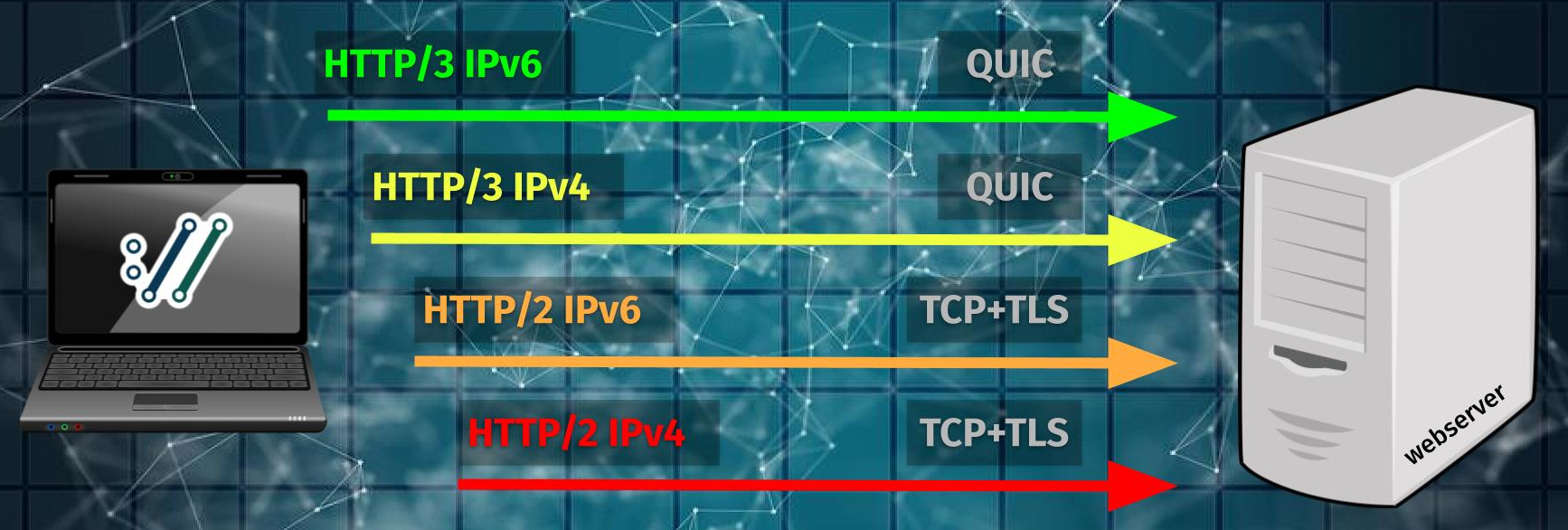
For each of these separate attempts, IPv6/IPv4 is also selected in the same kind of race against each other to pick the one that connects first. Potentially making up to four parallel connect attempts going on at the same time: QUIC-IPv6, QUIC-IPv4, TCP-IPv6 and TCP-IPv4!

I made a little drawing to visualize how the different connect attempts then might get initiated:

Multi-layered happy eyeballs

This is planned

I just want to be clear: this is what we plan to make work going forward. The code does not actually work like this just yet.

Update

In a slightly longer plan, before this feature is removed from its experimental state, we will probably remove both --http3 and --http3-only from the command line tool and instead create a more generic --http-versions options to maybe replace a lot of HTTP selection options. The exact functionality and syntax for this is yet to be worked out.

The underlying libcurl options might still remain as described in this blog post though.

curl -w certs

When a client connects to a TLS server it gets sent one or more certificates during the handshake.

Those certificates are verified by the client, to make sure that the server is indeed the right one: the server the client expects it to be; no impostor and no man in the middle etc.

When such a server certificate is signed by a Certificate Authority (CA), that CA’s certificate is normally not sent by the server but the client is expected to have it already in its CA store.

What certs?

Ever since the day SSL and TLS first showed up in the 1990s user have occasionally wanted to be able to save the certificates provided by the server in a TLS handshake.

The openssl tool has offered this ability since along time and is actually one of my higher ranked stackoverflow answers.

Export the certificates with the tool first, and then in subsequent transfers you can tell curl to use those certificates as a CA store:

$ echo quit | openssl s_client -showcerts -connect curl.se:443 > cacert.pem
$ curl --cacert cacert.pem https://curl.se/

This is of course most convenient when that server is using a self-signed certificate or something otherwise unusual.

(WARNING: The above shown example is an insecure way of reaching the host, as it does not detect if the host is already MITMed at the time when the first command runs. Trust On First Use.)

OpenSSL

A downside with the approach above is that it requires the openssl tool. Albeit, not a big downside for most people.

There are also alternative tools provided by wolfSSL and GnuTLS etc that offer the same functionality.

QUIC

Over the last few years we have seen a huge increase in number of servers that run QUIC and HTTP/3, and tools like curl and all the popular browsers can communicate using this modern set of protocols.

OpenSSL cannot. They decided to act against what everyone wanted, and as a result the openssl tool also does not support QUIC and therefore it cannot show the certificates used for a HTTP/3 site!

This is an inconvenience to users, including many curl users. I decided I could do something about it.

CURLOPT_CERTINFO

Already back in 2016 we added a feature to libcurl that enables it to return a list of certificate information back to the application, including the certificate themselves in PEM format. We call the option CURLOPT_CERTINFO.

We never exposed this feature in the command line tool and we did not really see the need as everyone could use the openssl tool etc fine already.

Until now.

curl -w is your friend

curl supports QUIC and HTTP/3 since a few years back, even if still marked as experimental. Because of this, the above mentioned CURLOPT_CERTINFO option works fine for that protocol version as well.

Using the –write-out (-w) option and the new variables %{certs} and %{num_certs} curl can now do what you want. Get the certificates from a server in PEM format:

$ curl https://curl.se -w "%{certs}" -o /dev/null > cacert.pem
$ curl --cacert cacert.pem https://curl.se/

You can of course also add --http3 to the command line if you want, and if you like to get the certificates from a server with a self-signed one you may want to use --insecure. You might consider adding --head to avoid the response body. This command line uses -o to write the content to /dev/null because it does not care about that data.

The %{num_certs} variable shows the number of certificates returned in the handshake. Typically one or two but can be more.

%{certs} outputs the certificates in PEM format together with a number of other details and meta data about the certificates in a “name: value” format.

Availability

These new -w variables are only supported if curl is built with a supported TLS backend: OpenSSL/libressl/BoringSSL/quictls, GnuTLS, Schannel, NSS, GSKit and Secure Transport.

Support for these new -w variables has been merged into curl’s master branch and is scheduled to be part of the coming release of curl version 7.88.0 on February 15th, 2023.

Workshop season 5 episode 2

Day one was awesome. Now we take the next step.

The missing people

During the discussions today it was again noticeable that apart from some specific individuals we also lack people in the room from prominent “players” in this area such as Chrome developers or humans with closer knowledge of how larger content deliverer work such as Netflix. Or what about a search engine person?

Years ago Chrome was represented well and the Apple side of the world was weak, but the situation seems to have been totally reversed by now.

The day

Mike Bishop talked about the complexities of current internet. Redirects before, during, after. HTTPS records. Alt-svc. Alt-SvcB. Use the HTTPS record for that alternative name.

This presentation triggered a long discussion on how to do things, how things could be done in a future and how the different TTLs in this scenario should or could interact. How to do multi-CDN, how to interact with DNS and what happens if a CDN wants to disable QUIC?

A very long discussion that mostly took us all back to square one in the end. The alt-svcb proposal as is.

Alan Frindell talked about HTTP priorities. What it is (only within connections, it has to be more than one thing and it something goes faster something else needs to go slower, re-prioritization takes a RTT/2 for a client to take effect), when to prioritize (as late as possible, for h2 just before committing to TCP).

Prioritizing images in Meta’s apps. On screen, close, not close. Guess first, then change priority once it knows better. An experiment going on is doing progressive images. Change priority of image transfers once they have received a certain amount. Results and conclusions are pending.

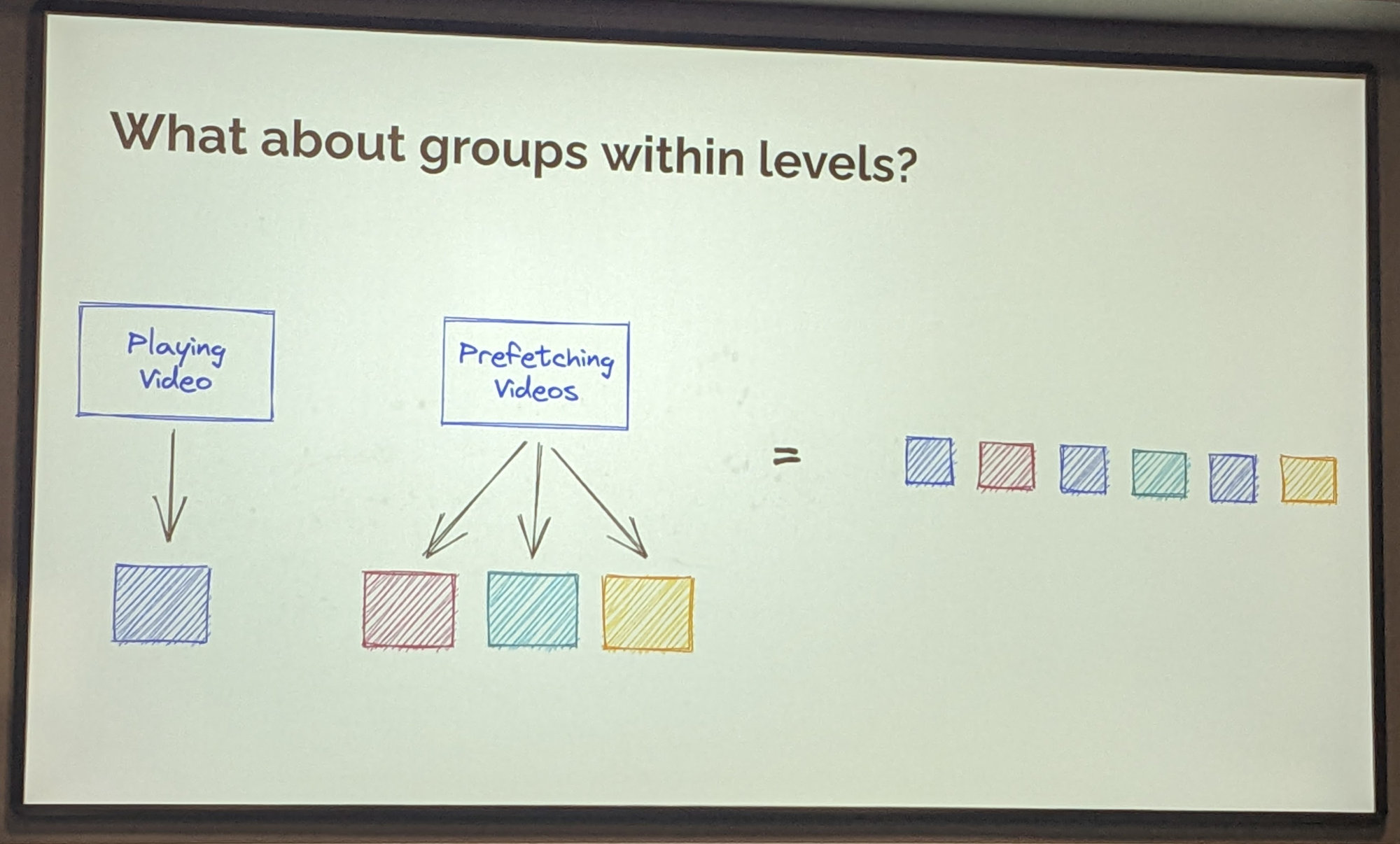
Priority within a single video. An important clue to successful priority handling seems to be more content awareness in the server side. By knowing what is being delivered, the server can make better decisions without the client necessarily having to say anything.

Lunch

I had Thai food. It was good.

Afternoon

Lucas Pardue talked about in HTTP vs tunneling over HTTP. Layers and layers of tunneling and packets within packets. Then Oblivious HTTP, another way of tunneling data and HTTP over HTTP. Related document: RFC 9297 – HTTP Datagrams and the Capsule Protocol. Example case on the Cloudflare blog.

Mark Nottingham talked on Structured Field Values for HTTP and the Retrofit Structured Fields for HTTP.

Who is doing SF libraries and APIs? Do we need an SF schema?

SF compression? Mark’s experiment makes it pretty much on par with HPACK.

Binary SF. Takes ~40% less time parsing in Mark’s experiment. ~10% larger in size (for now).

The was expressed interest in continuing this experimenting going forward. Reducing the CPU time for header parsing is considered valuable.

Sebastian Poreba talked “Networking in your pocket” about the challenges and architectures of mobile phone and smartwatch networking. Connection migration is an important property of QUIC that is attractive in the mobile world. H3 is good.

A challenge is to keep the modem activity off as much as possible and do network activities when the modem is already on.

Beers

My very important duties during these days also involved spending time in pubs and drinking beers with this awesome group of people. This not only delayed my blog post publish times a little, but it might also have introduced an ever so slight level of “haziness” into the process and maybe, just maybe, my recollection of the many details from the day is not exactly as detailed as it could otherwise have been.

That’s just the inevitable result of me sacrificing myself for the team. I did it for us all. You’re welcome.

Another full day

Another day fully packed with HTTP details from early to late. From 9am in the morning until 11pm in the evening. I’m having a great time. Tomorrow is the last day. I’ll let you know what happens then.

QUIC and HTTP/3 with wolfSSL

Disclaimer: I work for wolfSSL but I don’t speak for wolfSSL. I state my own opinions and I try to be as honest and transparent as possible. As always.

QUIC API

Back in the summer of 2020 I blogged about QUIC support coming in wolfSSL. That work never actually took off, primarily I believe because the team kept busy with other projects and tasks that had more customer focus and interest and yeah, there was not really any noticeable customer demand for QUIC with wolfSSL.

Time passed.

On July 21 2022, Stefan Eissing submitted his work on introducing a QUIC API and after reviews and updates, it was merged into the wolfSSL master branch on August 9th.

The QUIC API is planned to appear “for real” in a coming wolfSSL release version. Until then, we can play with what is available in git.

Let me be clear here: the good people at wolfSSL has not decided to write a full QUIC implementation, because that would be insane when so many good alternatives are already being worked on. This is just a set of new functions to allow wolfSSL to be used as TLS component when a QUIC stack is created.

Having QUIC support in wolfSSL is just one (but important) step along the way as it makes it possible to use wolfSSL to build a QUIC implementation but there are some more steps needed to turn this baby into full HTTP/3.

ngtcp2

Luckily, ngtcp2 exists and it is an established QUIC implementation that was written to be TLS agnostic from the beginning. This “only” needs adaptions provided to make sure it can be built and used with wolSSL as the TLS provider.

Stefan brought wolfSSL support to ngtcp2 in this PR. Merged on August 13th.

nghttp3

nghttp3 is the HTTP/3 library that uses ngtcp2 for QUIC, so once ngtcp2 supports wolfSSL we can use nghttp3 to do HTTP/3.

curl

curl can (as one of the available options) get built to use nghttp3 for HTTP/3, and if we just make sure we use an underlying ngtcp2 built to use a wolfSSL version with QUIC support, we can now do proper curl HTTP/3 transfers powered by wolfSSL.

Stefan made it possible to build curl with the wolfSSL+ngtcp2 combo in this PR. Merged on August 15th.

Available HTTP/3 components

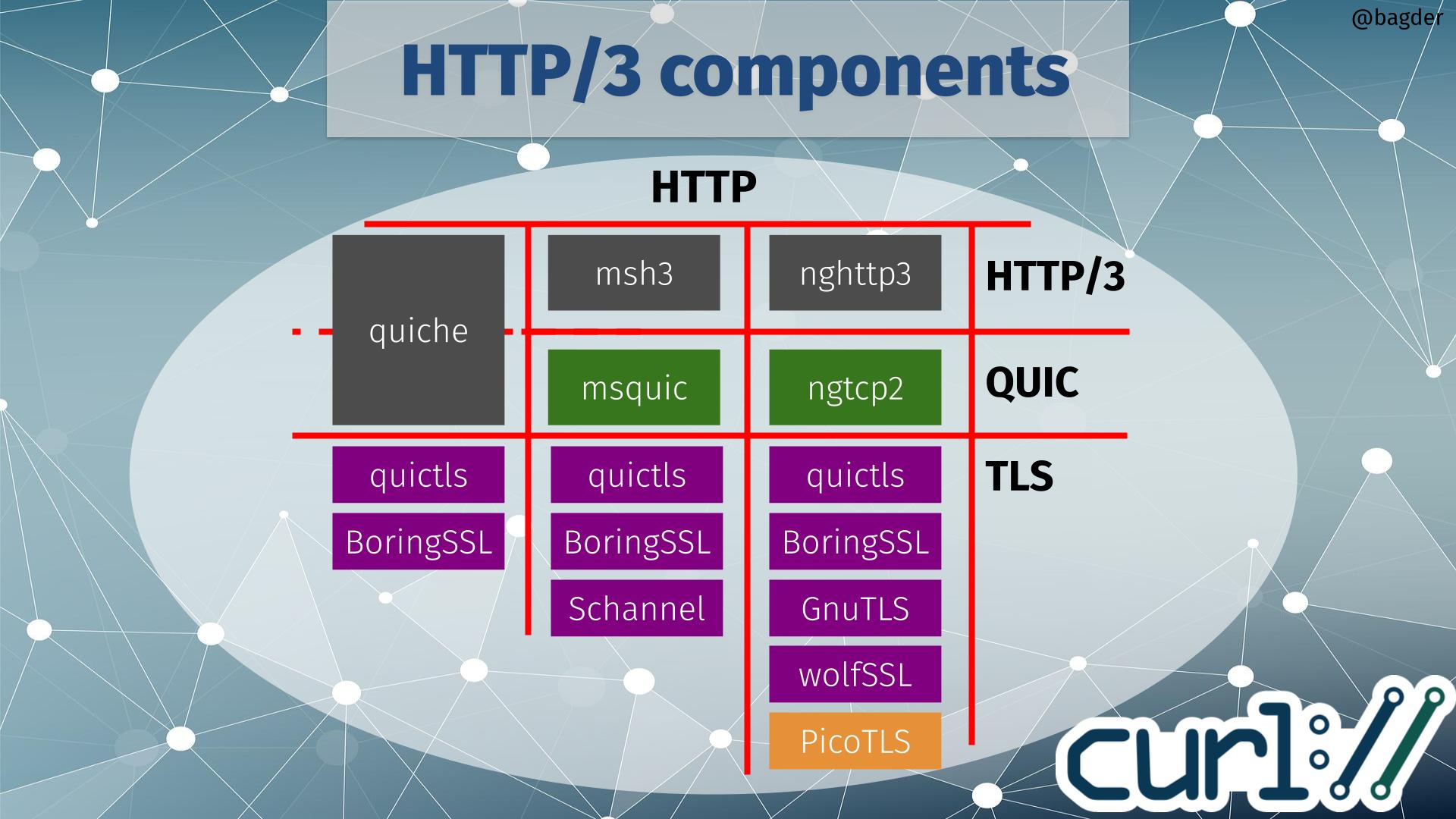
With this new ecosystem addition, the chart of HTTP/3 components for curl did not get any easier to parse!

If you start by selecting which HTTP/3 library (or maybe I should call it HTTP/3 vertical) to use when building, there are three available options to go with: quiche, msh3 or nghttp3. Depending on that choice, the QUIC library is given. quiche does QUIC as well, but the two other HTTP/3 libraries use dedicated QUIC libraries (msquic and ngtcp2 respectively).

Depending on which QUIC solution you use, there is a limited selection of TLS libraries to use. The image above shows TLS libraries that curl also supports for other protocols, meaning that if you pick one of those you can still use that curl build to for example do HTTPS for HTTP version 1 or 2.

TLS options

If you instead rather pick TLS library first, only quictls and BoringSSL are supported by all QUIC libraries (quictls is an OpenSSL fork with a BoringSSL-like QUIC API patched in). If you rather build curl to use Schannel (that’s the native Windows TLS API), GnuTLS or wolfSSL you have also indirectly chosen which QUIC and HTTP/3 libraries to use.

Picotls

ngtcp2 supports Picotls shown in orange in the image above because that is a TLS 1.3-only library that is not supported for other TLS operations within curl. If you build curl and opt to go with a ngtcp2 build using Picotls for QUIC, you would need to have use an second TLS library for other TLS-using protocols. This is possible, but is rarely what users prefer.

No OpenSSL option

It should probably be especially highlighted that the plain vanilla OpenSSL is not an available option. Primarily because they decided that the already created API was not good enough for them so they will instead work on implementing their own QUIC library to be released at some point in the future. That also implies that if we want to build curl to do HTTP/3 with OpenSSL in the future, we probably need to add support for a forth QUIC library – and someone would also have to write a HTTP/3 library to use OpenSSL for QUIC.

Why wolfSSL adding QUIC is good for HTTP/3

People in general want to build applications and infrastructure using released, official and supported libraries and the sad truth is that there is a clear shortage in such TLS libraries with QUIC support.

In your typical current Linux distribution, quictls and BoringSSL are usually not viable options. The first since it is an OpenSSL fork not many even ship as a package and the second because it is done by Google for Google and they don’t do releases and generally care little for outside-Google users.

For the situations where those two TLS options are out of the game, the image above shows you the grim reality: your HTTP/3 options are limited. On Windows you can go with msh3 since it can use Schannel there, but on non-Windows you can only use ngtcp2/nghttp3 and before this wolfSSL support the only TLS option was GnuTLS.

For many embedded solutions, or even FIPS requirements, wolfSSL is now the only viable option for doing HTTP/3 with curl.

The QUIC API OpenSSL will not provide

In a world that is now gradually adopting HTTP/3 (which, as you know, is implemented over QUIC), the problem with the missing API for QUIC is still a key problem.

There are a number of existing QUIC library implementation now since a few years back, and they are slowly maturing. The QUIC protocol became RFC 9000 and friends, but the most popular TLS libraries still don’t provide the necessary APIs to make QUIC libraries possible to use them.

Example that makes people want HTTP/3

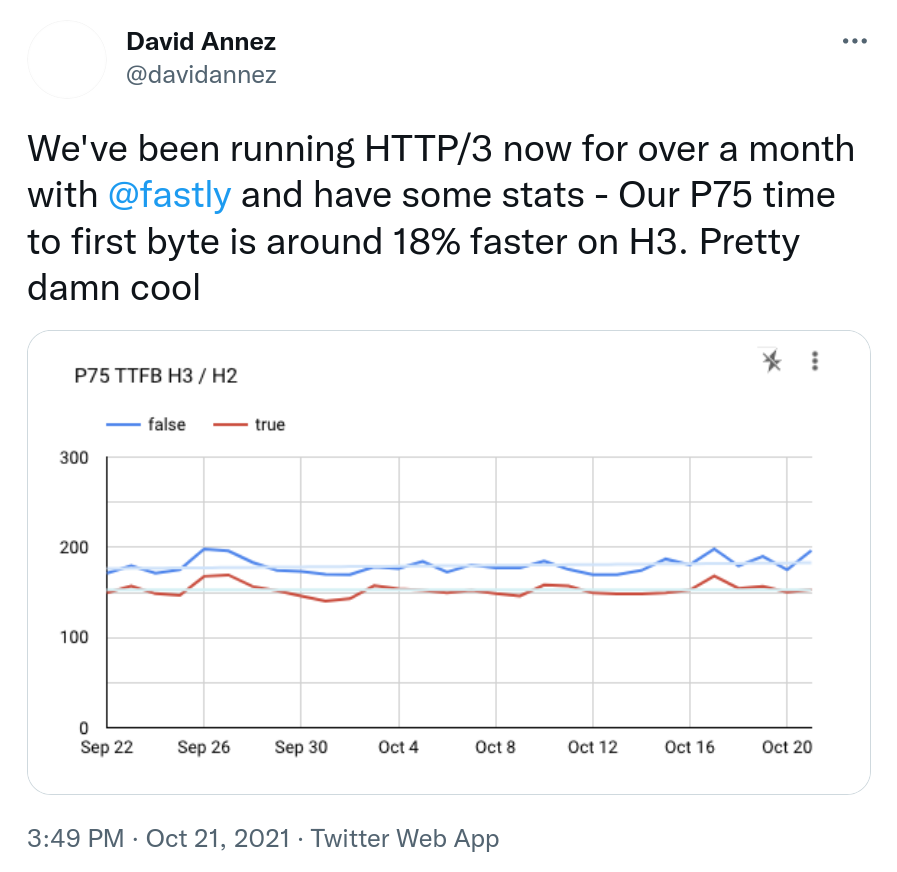
Example tweet of what makes people keen on experimenting and deploying HTTP/3.

OpenSSL PR8797

For a long time, many people and projects (including yours truly) in the QUIC community were eagerly following the OpenSSL Pull Request 8797, which introduced the necessary QUIC APIs into OpenSSL. This change brought the same API to OpenSSL that BoringSSL already provides and as such the API has already been used and tested out by several independent implementations.

Implementations have a problem to ship to the world based on BoringSSL since that’s a TLS library without versions and proper releases, so it is not a good choice for the big wide world. OpenSSL is already the most widely used TLS library out there and lots of applications are already made to use that.

Delays made quictls happen

The OpenSSL PR8797 was delayed back in February 2020 on when the OpenSSL management committee (OMC) decreed that they would not deal with that PR until after their pending 3.0.0 release had shipped.

“It is our expectation that once the 3.0 release is done, QUIC will become a significant focus of our effort.”

OpenSSL then proceeded and their 3.0.0 release was delayed significantly compared to their initial time schedule.

In March 2021, Microsoft and Akamai announced quictls, an OpenSSL fork with the express idea to ship OpenSSL + the QUIC API. They didn’t want to wait for OpenSSL to do it.

Several QUIC libraries can now use quictls. quictls has kept their fork up to date and now offers the equivalent of OpenSSL 3.0.0 + the QUIC API.

While we’ve been waiting for OpenSSL to adopt the API.

OpenSSL makes a turn instead

Then came the next blow to everyone’s expectations. An autumn surprise. On October 13, the OpenSSL OMC announces:

The focus for the next releases is QUIC, with the objective of providing a fully functional QUIC implementation over a series of releases (2-3).

OpenSSL has decided to implement a complete QUIC stack on their own and with the given time line it sounds like it will take them a few years (?) to ship. And instead of providing the API lots of implementers have been been waiting for so long, they explicitly say that it is a non-goal at the start:

The MVP will not contain a library API for an HTTP/3 implementation (it is a non-goal of the initial release).

I didn’t write my own QUIC implementation but I’ve followed the work of several of the implementations fairly closely and it is fairly complicated journey they set out for themselves – for very unclear reasons. There already exist several high quality QUIC libraries, why does OpenSSL think they need to make yet another one? They seem to be overloaded with work already before, which the long delays of the 3.0.0 release seemed to show, how are they going to be able to add a complete new stack implementation of top of this? The future will tell.

PR8797 closed

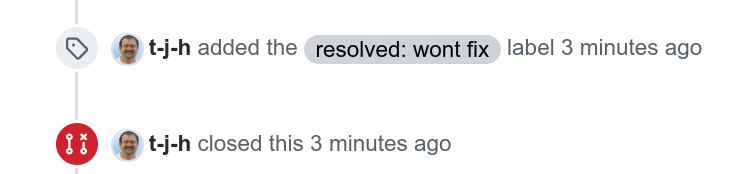
On October 20 2021, the pull request that was created in April 2019, is finally closed for real as a “won’t fix”.

Screenshot of the actual closing of the PR

Where are we now?

The lack of a QUIC API in OpenSSL has held us back and with this move from OpenSSL, it will continue to hold us back for an uncertain amount of time going forward.

QUIC stacks will have to stick to using or switching to other libraries.

I’m disappointed.

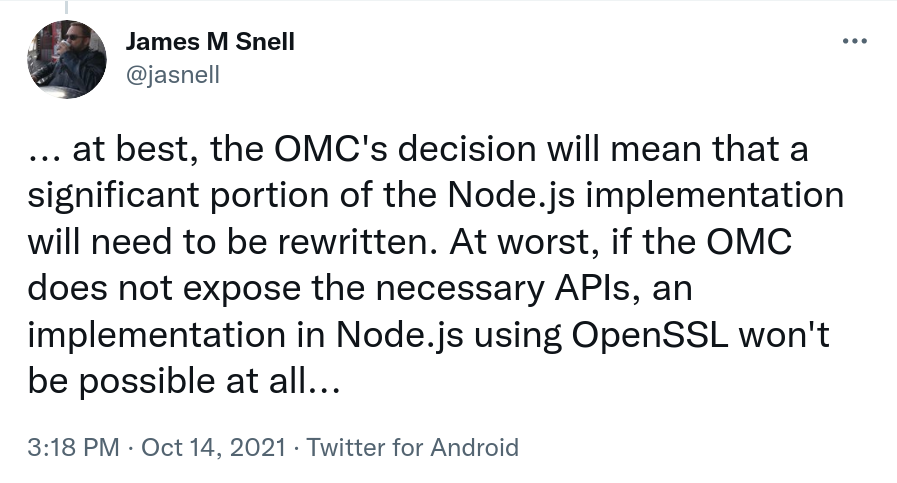
James Snell, one of the key contributors on the QUIC and HTTP/3 work in nodejs tweeted:

Credits

Image by Marzena P. from Pixabay