Better pipelining in libcurl 7.30.0

Tuesday, March 26th, 2013

Back in October 2006, we added support for HTTP pipelining to libcurl. The implementation was naive and simple: it basically preferred to pipeline everything on the single connection to a given host if it could. It works only with the multi interface and if you do a second request to the same host it will try to pipeline that.

pipelines

Over the years the feature was bugfixed and improved slightly, which proved that at least a couple of applications actually used it – but it was never any particularly big hit among libcurl’s vast amount of features.

Related background information that gives details on some of the problems with pipelining in the wild can be found in Mark Nottingham’s Making HTTP Pipelining Usable on the Open Web internet-draft, Mozilla’s bug report “HTTP pipelining by default” and Chrome’s pipelining docs.

Now, more than six years later, Linus Nielsen Feltzing (a colleague and friend at Haxx) strikes back with a much improved and almost completely revamped HTTP pipelining support (merged into master just hours before the new-feature window closed for the pending 7.30.0 release). This time, the implementation features and provides:

  • a configurable number of connections and pipelines to each unique host name
  • a round-robin approach that favors starting new connections first, and then pipeline on existing connections once the maximum number of connections to the host is reached
  • a max-depth value that when filled makes the code not add any more requests on that connection/pipeline
  • a pipe penalization system that avoids adding new requests to pipes that are known to be receiving very large contents and thus possibly would stall subsequent requests for an extended period of time
  • a server blacklist that allows the application to specify a list of servers for which HTTP pipelining should not be attempted – real world tests has proven that some servers are too broken to be allowed to play the game

The code also adds a feature that helps out applications to do massive amount of requests in a controlled manner:

A hard maximum amount of connections, that when reached makes libcurl queue up easy handles internally until they can create a new connection or re-use a previously used one. That allows an application to for example set the limit to 50 and then add 400 handles to the multi handle but it will still only use 50 connections as a maximum so over time when requests get completed it will start new transfers on the requests that are waiting in line and thus shrinking the queue and keeping the maximum amount of connections until there’s less than 50 left to do…

Previously that kind of queuing had to be done by the application itself, but now with the much more extensive pipelining support it really isn’t as easy for an application to know when the new request can get pipelined or create a new connection so this logic is now provided by libcurl itself. It is likely going to be appreciated and used also by non-pipelining applications…

This implementation is accompanied with a bunch of new test cases for libcurl (and even a new HTTP test server for the purpose), and it has been tested in the wild for a while with libcurl as the engine in a web browser implementation (the company doing that has requested to remain anonymous). We believe it is in fairly decent state, but as this is a large step and the first release it is shipped with I expect there to be some hiccups along the way.

Two things to take note of:

  1. pipelining is only available for users of libcurl’s multi interface, and only if explicitly enabled with CURLMOPT_PIPELINING
  2. the curl command line tool does not use the multi interface and thus it will not use pipelining

“haking”

Friday, November 30th, 2012

(This is an authentic email we received at Haxx the other day. Names, emails and URLs are replaced in this excerpt to save the innocent)

Date: Thu, 29 Nov 2012 14:59:25
Subject: haking

hello, can you tell me how to hack into web site:
[FIRST URL]
so it is showing:

[OTHER URL]
when you click on a link in google results?

for example if you click on a google result:
[URL to a google.rs search for something on the FIRST URL site]

the point is i would like to protect my web site form that kind of attack so please let me know how to do that

how did i found you? there is your address at [FIRST URL]/coockies.txt so i think you did it, but was polite enough to leave address.. please help me.

Of course I was curious enough to check the “coockies.txt” file, and the beginning of that file looked like this:

# Netscape HTTP Cookie File
# http://curlm.haxx.se/rfc/cookie_spec.html
# This file was generated by libcurl! Edit at your own risk.
[FIRST URL] FALSE	/	FALSE	0	PHPSESSID	dfn1a5ll0hs8odpfh3p2qtlcj3

This tells us a few trivial things, all of which might not be obvious to the untrained eye:

  • The file was generated by libcurl that was 7.16.0 or later, but no later than 7.18.3 as we only used the URL in that file between those releases.
  • The spelling of that cookie file is so hilarious we can guess it wasn’t a native English speaker who named it. The subject of the email is similarly bad so perhaps it was a fellow countryman of Serbia? (the TLD of the google URL was .rs after all)
  • The person doing this didn’t even try to clean up the remaining junk file(s) afterwards
  • The guy sending me the email is completely in the blue of what has happened or even who he’s contacting or my relation to this all.
  • The world can be a harsh and cruel place and it isn’t easy to know your way around all of it…

Meet Haxx at FOSDEM 2013

Sunday, November 4th, 2012

Keeping up with our fine tradition, we will be present at that huge open source conference called FOSDEM in Brussels Belgium at the beginning of February 2013. It will then become our… 4th (?) visit there. I don’t have any talk planned yet, but possibly I’ll suggest something later.

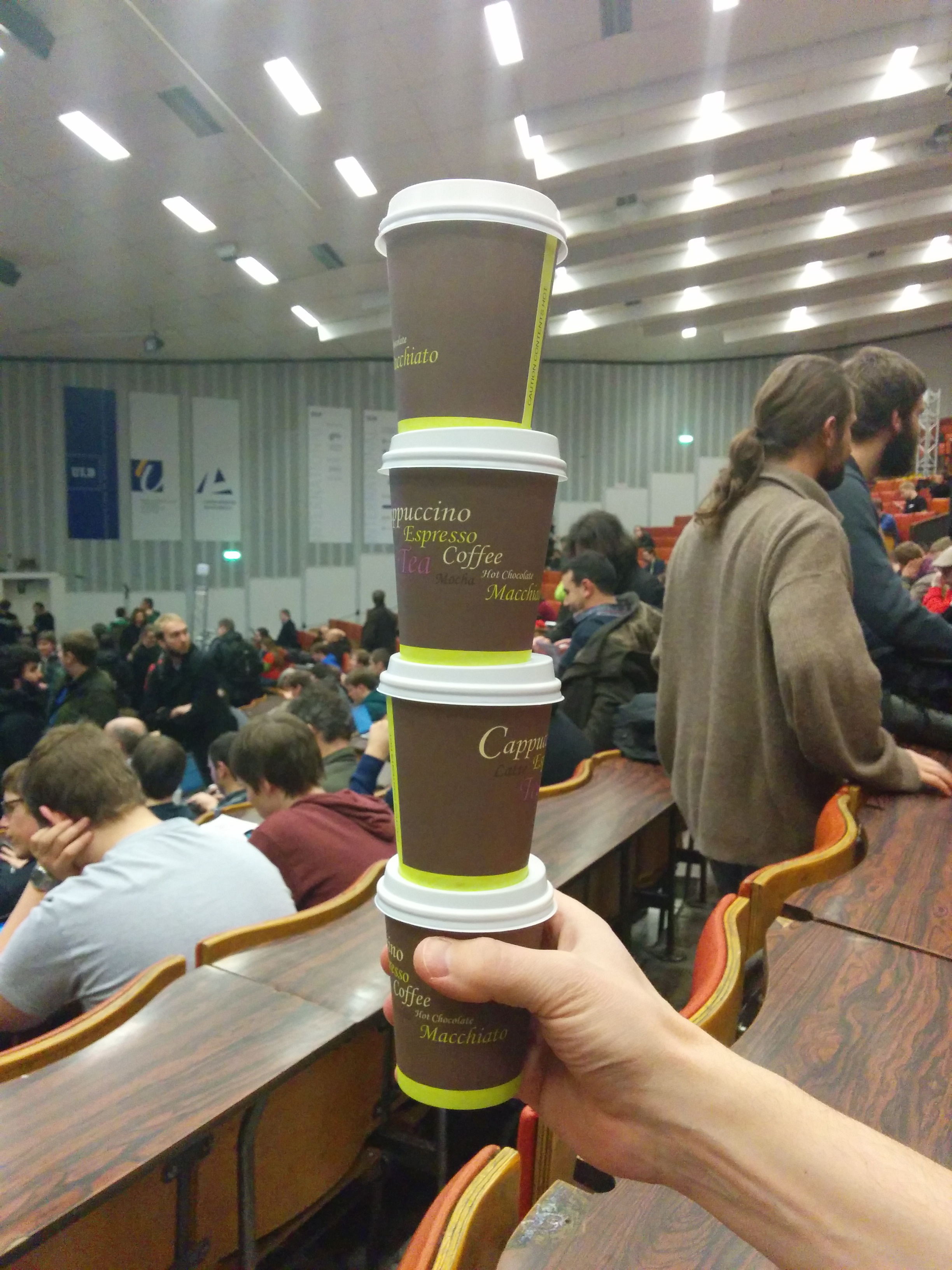
Fosdem is several thousand open source geeks in a massive scale conference with something like twenty different parallel tracks, where each room basically is organized and planned independently. There’s no registration and no entrance fee. I usually enjoy network and security related rooms and of course the embedded room, which unfortunately seems to be stuck in a very large room of the campus with the worst sound system and audio conditions…

I look forward to meet friends there and have a great time with open source talks and good Belgian beers at night! If you’ll be there too, let us know and we can meet up.

fosdem

Embedded Linux hacking day

Monday, October 22nd, 2012

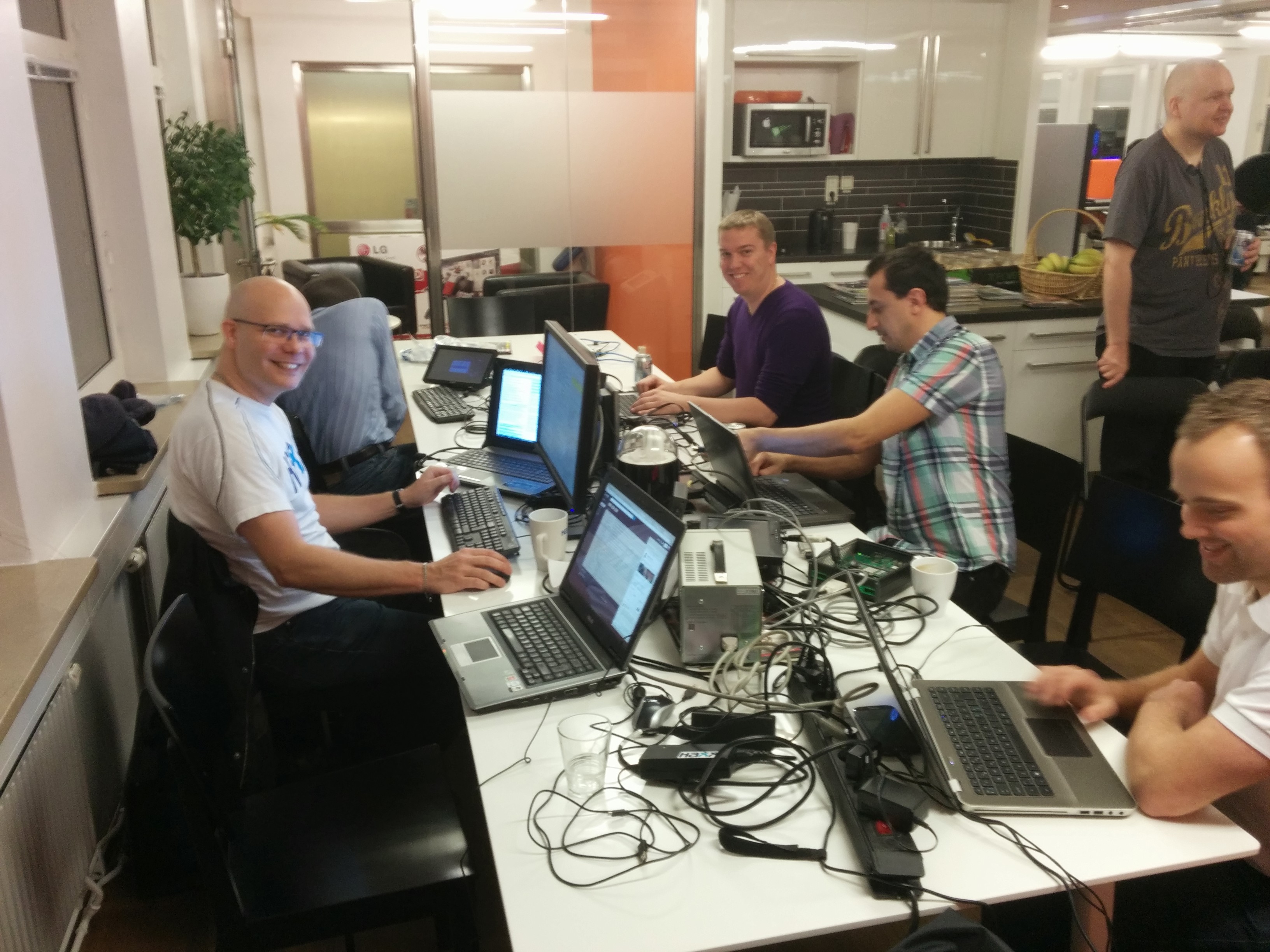
eneaOn September 10th, I sent out the invite to the foss-sthlm community for an embedded hacking event just before lunch. In just four hours, the 40 available tickets had been claimed and the waiting list started to get filled up as well… I later increased the amount to 46, we had some cancellations and I handed out more tickets and we had 46 people signed up at the day of the event (I believe 3 of these didn’t show up). At the day the event started, we still had another 20 people in the waiting list with hopes of getting a spot!

(All photos in this post are scaled down versions, click the picture to see a slightly higher resolution version!)

In Enea we had found an excellent sponsor for this event. They provided the place, the food, the raspberry pis, the coffe, the tshirts, the infrastructure and everything else that had to be there to make it an awesome day.

the-roomWe started off the event at 10:00 on October 20 in the Enea offices in Kista, Stockholm Sweden. People dropped in one by one and were handed their welcome present containing a raspberry pi board, a 2GB SD card and a USB-to-serial cable to interface/power the board with. People then found their seats in the room.

There were fruit, candy, water and coffee to start off and keep the mood high. We experienced some initial wifi and internet access problems but luckily we had no less than two dedicated Enea IT support people present and they could swiftly fix the little hiccups that occurred.

coffee machines

Once everyone seemed to have landed, I welcomed everyone and just gave a short overview of what to expect from the day, where the toilets are and so on.

In order to try to please everyone who couldn’t be with us at this event, due to plans or due to simply not having got one of the attractive 40 “tickets”, Björn the cameramanEnea helped us arrange a video camera which we used during the entire day to film all talks and the contest. I can’t promise any delivery time for them but I’ll work on getting them made public as soon as possible. I’ll make a separate blog post when there’s something to see. (All talks were in Swedish!)

At 11:30 I started off the day for real by holding the first presentation. We used one of the conference rooms for this, just next to the big room where everyone say hacking. This day we had removed all tables and only had chairs in the room movie theater style and it turned out we could fit just about all attendees in the room this way. I think that was good as I think almost everyone sat down to hear and see me:

Open Source in Embedded Systems

daniel talks open source I did a rather non-technical talk about a couple of trends in the embedded operating systems market and how I see the upcoming future and then some additional numbers etc. The full presentation (with most of the text in Swedish) can be found on slideshare.

I got good questions and I think it turned out an interesting discussion on how things run and work these days.

After my talk (which I of course did longer than planned) we served lunch. Three different sallads, bread and stuff were brought out. Several people approached me to say how they appreciated the food so I must say that Enea managed really well on that account too!

Development and trends in multicore CPUs

jonas talks about CPUs
Jonas Svennebring from Freescale was up next and talked about current multicore CPU development trends and what the challenges are for the manufacturers are today. It was a very good and very technical talk and he topped it off by showing off his board with T4240 running, Freecale’s latest flagship chip that is just now about to become available for companies outside of Freescale.

T4240 from FreeescaleOn this photo on the left you see the power supply in the foreground and the ATX board with a huge fan and cooler on top of the actual T4240 chip.

T4240 is claimed to have a new world record in coremark performance, features 12 hyper-threaded ppc cores in up to 1.8GHz.

There were some good questions to Jonas and he delivered good and well thought out answers. Then people walked out in the big room again to continue getting some actual hacking done.

We then took the opportunity to hand out the very nice-looking tshirts to all attendees, again kindly done so by Enea.

The Contest

The next interruption was the contest. Designed entirely by me to allow everyone to participate, even my friends and Enea employees etc. On the photo on the right you can see I now wear the tshirt of the day.

the contest
The contest was hard. I knew it was hard as I wanted it really make it a race that was only for the ones who really get embedded linux and have their brain laid out properly!

I posted the entire contest in separate blog post, but the gist of it was that I presented 16 questions with 3 answer alternatives. Each alternative had a sequence of letters. So after 16 questions you had 16 letter sequences you had to put in the right order to get a 17th question. The first one to give a correct answer to that 17th question would win.

A whole bunch of people gave up immediately but there was a core group who really fought hard, long and bravely and in the end we got a winner. The winner had paired up so the bottle of champagne went jointly to Klas and Jonas. It was a very close call as others were within seconds of figuring it out too.

I think the competition was harder than I thought. Possibly a little too hard…

Your own code on others’ hardware

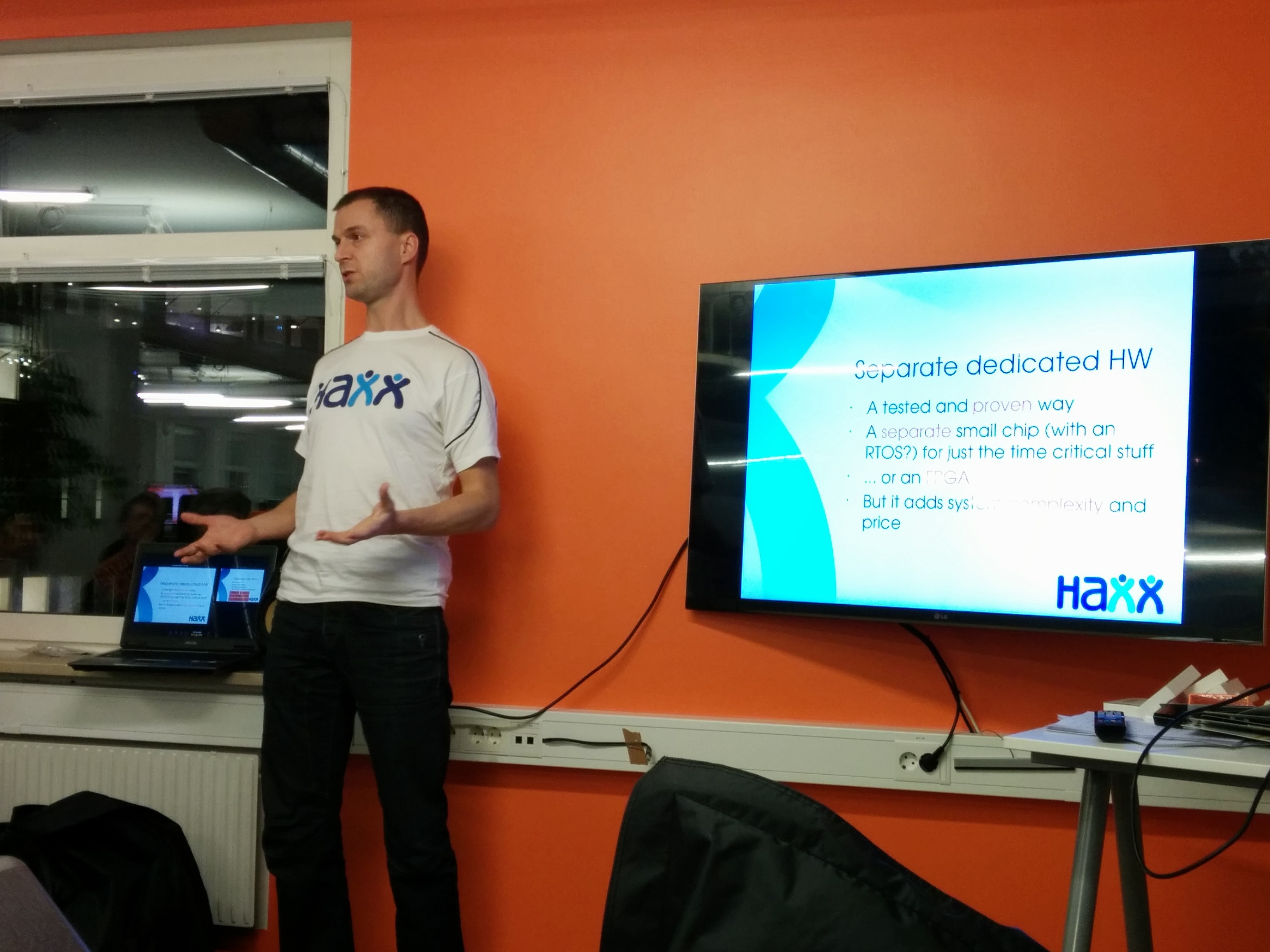
linus talksLinus from Haxx (who shouldn’t be much of a stranger to readers of this blog) then gave some insights on how he reversed engineered mp3 players for the Rockbox project. Reverse engineering is a subject that attracts many people and I believe it has some sort of magic aura around it. Again many good questions and interested people in the room.

Linus bare targets as seen during his talk On the photo on the right you can see Linus’ stripped down hardware which he explained he had ripped off all components from in order to properly hunt down how things were connected on the PCB.

Coffee

We did not keep the time schedule so we had to get the coffee break in after Linus, and there were buns and so on.

Yocto

Björn from Haxx then educated the room on the Yocto Project. What it is, why it is, who it is and a little about how it is designed and how it works etc.

bjorn talks on yocto

I think perhaps people started to get a little soft in their brain as we had now blasted through all but one of the talks, and as a speaker finale we had Henrik…

u-boot on Allwinner A10

Henrik Nordström did a walk-through explaining some u-boot basics and then explained what he had done for the Allwinner targets and related info.

Henrik talks u-boot
I believe the talks were kind of the glue that made people stick around. Once Henrik was done and there was no more talks planned for the day, it was obvious that it was sort of the signal for people to start calling it a day even though there was still over one hour left until the official end time (20:00).

Henriks hardware
Of course I don’t blame anyone for that. I had hardly had any time myself to sit down or do anything relaxing during the day so I was kind of exhausted myself…

Summary

I got a lot of very positive comments from people when they left the facilities with big smiles on their faces, asking for more of these sorts of events in the future.

The back of the Enea tshirtI am very happy with the overly positive response, with the massive interest from our community to come to such an event and again, Enea was an awesome sponsor for this.

Talk audienceI didn’t get anything done on the raspberry pi during this day. As a matter of fact I never even got around to booting my board, but I figure that wasn’t a top priority for me this day.

The crowd size felt really perfect for these facilities and 40 something also still keeps the spirit of familiarity and it doesn’t feel like a “big” event or so.

Will I work on making another event similar to this again? Sure. It might not happen immediately, but I don’t see why it can’t be made again under similar circumstances.

Credits

rpi accessed with tabletAll photos on this page were taken by me, Björn Stenberg, Kjell Ericson, Mats Lidell and Mia Åkerström.

Thanks to Jonas, Björn, Linus and Henrik for awesome talks.

Thanks to Enea for sponsoring this event, and Mia then in particular for being a good organizer.

this vs that and ssh through proxy

Tuesday, October 2nd, 2012

Taken from the web stats for daniel.haxx.se during September 2012. The top-10 search phrases used to end up on a page on this site:

  1. ssh proxy (198)
  2. curl vs wget (145)
  3. ftp vs http (92)
  4. wget vs curl (91)
  5. ssh through proxy (72)
  6. http vs ftp (67)
  7. curl wget (55)
  8. wget curl (53)
  9. http ftp (46)
  10. difference between ftp and http (45)

The top-3 most visited pages on my site during the same month were:

  1. SSH Through or Over Proxy (viewed 4800 times)
  2. curl vs Wget (viewed 3000 times)
  3. FTP vs HTTP (viewed 2300 times)

I guess this tells me something. I’m not sure what…

Three years of Haxx

Monday, October 1st, 2012

Haxx logoAt October first, another full year of work at Haxx has been spent since I last summed up the past year (my previous posts about Haxx’s first year and second year). Three years working for Haxx full-time, and it has been another great year with lots of fun, challenges and us enjoying being independent.

During this year I ended my previous engagement with that large chip company and got a new assignment for the same customer both Björn and Linus were working for at the time. It has been a big adventure for me as I dove straight into unknown territories and I’ve spent my work days since then as a product manager, making an embedded Linux distribution. In this role I’ve travelled to US, China and South Korea during the year and I’m serving as a member of an advisory board in a related organization on behalf of my customer! I recently agreed to extending this contract to at least April 2013. Partly due to this new assignment I’ve not worked very much on foss-sthlm activities recently, but after the summer I’ve really made an effort to get this back up to speed.

Birthdaycake

Later during the year, Linus changed assignment to a new customer when we signed a sort of partnership contract with a leading global embedded software company and he then continued to do a whole series of little projects for them. After the summer Linus has grabbed a couple of curl related projects, partly still in progress.

Björn stuck around at the same customer during the entire year, and he’s been working as an engineer and developer in the team that actually makes the product I am a manager for.

Haxx towelThis year we made more Haxx merchandise. Towels, stickers and jackets have now been sent out in the world to make our name more visible in a few weird corners of the universe.

We visisted FSCONS 2011 and FOSDEM 2012, two really nice conferences for FOSS fans like us and we got to meet a lot of friends and like-minded people there.

We continue to see a demand on the market for highly skilled embedded developers, including embedded Linux and open source related activities. We wouldn’t mind extending our merry team, so we decided to document a list of requirements of what to have in order to get hired by us. So far not a single person has applied…

Snaxx 27

Tuesday, September 25th, 2012

A pint of guinnessGoing strong after 12 years in the making. For the 27th time we’re gathering friends in the Stockholm Sweden area who are interested in technology, open source, beers, slightly inaccurate Monty Python quotes, reverse engineering electronics and similar very important topics. We might also have a beer or two and talk rubbish.

On October 31st 2012 we invite all and every of our tech oriented friends to visit

Snaxx-27

We figured the 27th time would be the perfect time to do something new, so we now host the information on the fine snaxx.se domain.

The official 2012 Haxx towel

Thursday, July 26th, 2012

Haxx-towel

We may not get a very warm and sunny summer this year in Sweden, but now at least we have the Haxx towels to use the very brief moments on the beach! It measures 140 x 70 centimeters and if you click on the image you’ll get a higher resolution version to browse.

Travel for fun or profit

Thursday, March 15th, 2012

As a protocol geek I love working in my open source projects curl, libssh2, c-ares and spindly. I also participate in a few related IETF working groups around these protocols, and perhaps primarily I enjoy the HTTPbis crowd.

Meanwhile, I’m a consultant during the day and most of my projects and assignments involve embedded systems and primarily embedded Linux. The protocol part of my life tends to be left to get practiced during my “copious” amount of spare time – you know that time after your work, after you’ve spent time with your family and played with your kids and done the things you need to do at home to keep the household in a decent shape. That time when the rest of the family has gone to bed and you should too but if you did when would you ever get time to do that fun things you really want to do?

IETF has these great gatherings every now and then and they’re awesome places to just drown in protocol mumbo jumbo for several days. They’re being hosted by various cities all over the world so often I deem them too far away or too awkward to go to, also a lot because I rarely have any direct monetary gain or compensation for going but rather I’d have to do it as a vacation and pay for it myself.

IETF 83 is going to be held in Paris during March 25-30 and it is close enough for me to want to go and HTTPbis and a few other interesting work groups are having scheduled meetings. I really considered going, at least to meet up with HTTP friends.

Something very rare instead happened that prevents me from going there! My customer (for whom I work full-time since about six months and shall remain nameless for now) asked me to join their team and go visit the large embedded conference ESC in San Jose, California in the exact same week! It really wasn’ t a hard choice for me, since this is my job and being asked to do something because I’m wanted is a nice feeling and position – and they’re paying me to go there. It will also be my first time in California even though I guess I won’t get time to actually see much of it.

I hope to write a follow-up post later on about what I’m currently working with, once it has gone public.

I’m interviewed by foss-magasin

Sunday, December 11th, 2011

foss-magasin

Claes at foss-magasin.se asked a bunch of questions about me, my commitments within the FOSS community and related matters recently over email. This Swedish interview just now went public: Daniel Stenberg – cURL, Rockbox och FOSS-Sthlm.

For my international friends who don’t understand the Swedish: I am quite happy with the questions and being allowed to answer them at this lengths etc, so I am considering doing a full translation of it and posting it at a later date.